Portugal NHR 2.0 (IFICI): How the Tax Regime Really Works
Portugal’s IFICI tax incentive regime explained in clear language. What consultants, tax lawyers and technical guides present as an opportunity for new residents — and the mechanisms, limits and structural asymmetries affecting local professionals that the public narrative tends to omit.
NHR 2.0 / IFICIPolicy AnalysisTax Regime
▶️ Video explainer
A simplified visual walkthrough of how Portugal’s TISRI (NHR 2.0 / IFICI) regime works in practice — following the path of a typical high-skilled professional and contrasting it with the reality faced by long-term local residents. By breaking down the mechanics step by step, the video highlights how identical work can be taxed in fundamentally different ways, and how those differences translate into real economic incentives that reshape hiring decisions, wages, and competition.
🎧 Podcast
An in-depth discussion of how IFICI works, the gap between new and long-term residents, and its practical effects on work, wages and housing.
What This Publication Is About
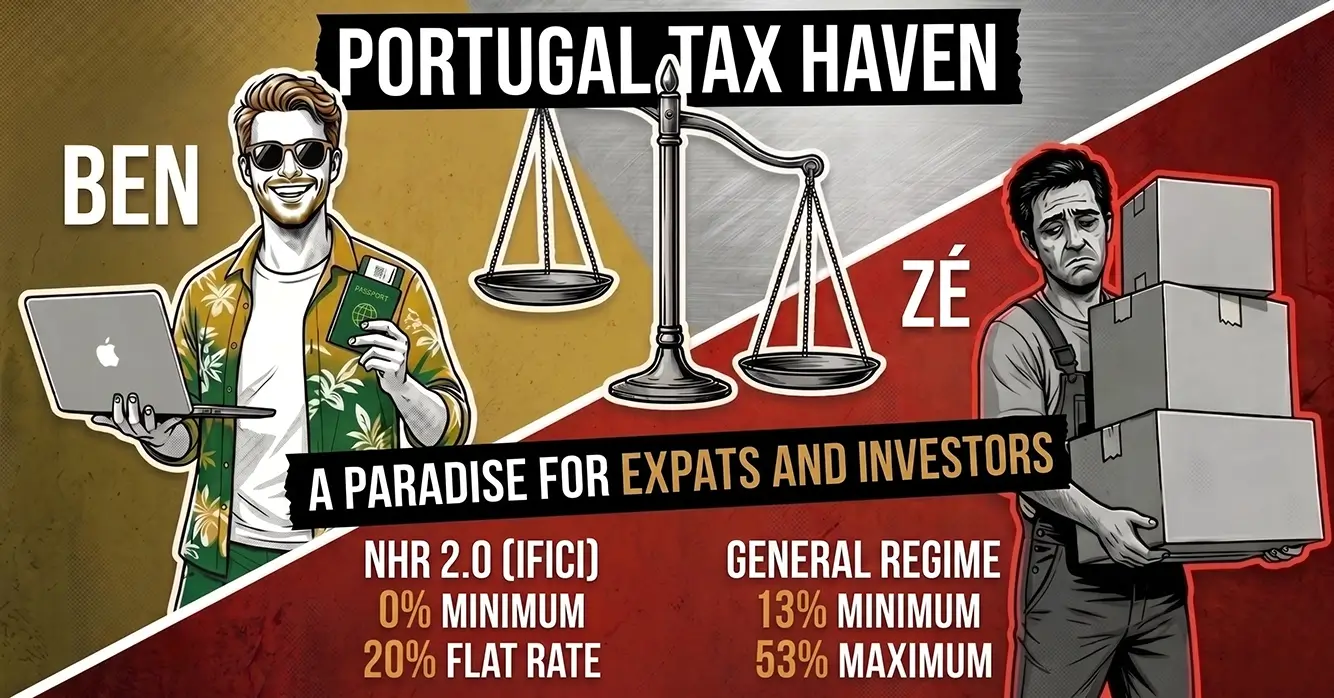
A simplified visual summary of the TISRI (NHR 2.0 / IFICI) framework and the tax asymmetries explored in this publication.
This publication simplifies and interprets the IFICI regime based on public information. Its aim is to explain, in a clear and accessible way, how Portugal's IFICI tax regime — commonly referred to as NHR 2.0 — works and which mechanisms are used by new residents to significantly reduce their tax burden.
Through practical examples and direct comparisons, it shows how different structures — a single-shareholder company, a foreign holding company, an Employer of Record, or simply already having international clients — may allow a professional to pay 20% in Portugal and, in some cases, achieve a very low or even 0% effective tax burden on foreign-source income, when the applicable legal conditions and treaty rules are met.
In the case of certain categories of foreign-source passive income, this outcome does not constitute an exception but rather a normal consequence of how the regime applies under the legal framework, being described in legal analyses as a broad exemption framework under specific conditions.
The contrast begins with the programme’s official name: Tax Incentive for Scientific Research and Innovation (IFICI). This breadth is not merely a critical interpretation. A Pérez-Llorca legal briefing on qualified job positions and economic activities recognised by AICEP/IAPMEI confirms that IFICI may cover general managers, executive managers, corporate officers, finance specialists, ICT professionals, as well as hospitality, restaurants and similar activities, holding companies and licensed fund management.
When “innovation” comes to include hotel management, restaurants, holding companies, consulting and fund management, the name of the regime no longer clearly describes its practical scope and also starts to function as a narrative of legitimation.
That name contains a measurable promise: more research, more innovation, more science in Portugal. This publication examines how the regime works in practice, who benefits from it, and what is known — and not known — about whether it is delivering what it promised.
ℹ️ Important limitation on tax risks
Some of the structures described — particularly those involving foreign companies — may be reviewed by the Portuguese Tax Authority. Concepts such as effective management, permanent establishment, CFC rules and anti-abuse provisions may affect the acceptance of these arrangements. This publication reflects how these strategies are presented in the market and in public materials, and does not imply that all configurations are risk-free or automatically compliant.
Some commercial explanations of the regime explicitly highlight the use of international structures, corporate entities, and pre-move tax planning as key elements in accessing Portugal’s TISRI (NHR 2.0 / IFICI) framework — made possible by its reliance on formal eligibility criteria rather than prior case-by-case approval. While often presented in terms of employment income, the most significant effects of the regime arise in relation to foreign passive income and capital gains.
The supporting evidence, official notices and institutional sources are available below for readers who want to verify the legal and documentary basis before moving to the practical example.
📊 How the regime is presented in practice (real-world examples)
How the regime is presented by the private sector
Beyond video explainers and publicly available materials, similar outcomes are also described in written publications produced by tax advisory firms.
A 2026 publication by a tax advisory firm, authored by a Head of Tax, states that under the NHR 2.0 / IFICI regime:
“This will give you: A complete exemption on virtually all foreign-source income.”
The same source also clarifies that access to the regime may involve working through a Portuguese company, including one owned by the individual:
“the new NHR 2.0 (IFICI) also requires that you work for a Portuguese company (even if that’s your own company)”
In an official Touchdown video, a Portuguese tax lawyer explains that a person carrying out a qualifying activity may create their own company in Portugal, become its manager or employee and provide services to existing clients through that structure.
When describing the resulting tax treatment, he states:
“Everything you move through Portugal, 20%. Everything abroad is zero, including capital gains, dividends, interest income, rental income.”
The presenter then characterises the regime as:
“Probably one of the most lucrative and attractive tax regimes in the developed world.”
A similar interpretation appears in another publication aimed at internationally mobile taxpayers, which presents the new regime as an opportunity to obtain reduced taxation in Portugal through qualifying activities and Portuguese corporate structures.
" The new scheme is somewhat more complex in terms of its structure, but it is generally more favorable than the old scheme , because, for example, profits on shares (so-called capital gains) are now also exempt."
This reading is reflected across international financial media. A World Finance article frames IFICI within the context of record global wealth migration. In other words: a regime officially designed to foster science and innovation appears, in the international market, positioned as a key catalyst for attracting high-net-worth individuals (HNWIs). The article stresses that access to the regime requires careful structuring, framing IFICI as a central element in a broader offering of tax planning and corporate structuring.
“Portugal leads Europe’s millionaire migration boom. Portugal is emerging as Europe’s leading magnet for high-net-worth individuals, thanks to its new tax regime for innovation and research, lifestyle appeal and strategic access to the EU.”
Projected net flows of high-net-worth individuals (HNWIs) for 2025. Portugal appears among the leading global destinations, with +1,400 millionaires and USD 8.1 billion in associated investable wealth. 📊 Source: Henley Private Wealth Migration Report 2025.
“For someone with existing offshore wealth structures (Channel Islands, Isle of Man, offshore investment managers), this is straightforward. For those without existing structures, it requires establishing them before relocation.”
The logic of pre-move structuring is laid out here with unusual clarity. In this reading, IFICI does not merely accommodate foreign-source wealth — it appears to favour those who already have international wealth structures or can create them before becoming tax resident in Portugal.
The commercialisation of structures tailored to the regime is also publicly visible among corporate service providers. In an article by 1st Step Solution, the incorporation of a Maltese company is presented as an optimised solution for Portugal residents under IFICI. The text describes Malta as a European jurisdiction with an effective corporate tax rate that may be close to 5% in certain scenarios, with no withholding tax on dividends distributed to non-residents. This architecture confirms that IFICI operates, in practice, not only as an individual tax residence regime, but also as a cross-border corporate structuring product.
The “Malta + IFICI” structure helps illustrate the mechanics behind the 35% rule. Portuguese law applies this rate to income arising from jurisdictions listed as having clearly more favourable tax regimes — the so-called “blacklist” of tax havens. In practice, if income destined for an IFICI / NHR 2.0 beneficiary first passes through a company in a European jurisdiction that is not on that list, such as Malta, the entity formally paying the dividend changes. That formal change may allow the income to reach Portugal within the IFICI exemption framework. In simple terms: capital may originate in a fiscally privileged jurisdiction, pass through a Maltese holding company, and be received by the beneficiary under a more favourable tax classification — potentially benefiting, in certain cases, from personal income tax exemption.
This grammar of optimisation is also discussed in international technical forums. In a Portugal Pathways webinar on IFICI, featuring specialists from BDO and CMS Law, the regime is examined through its two central dimensions: the 20% flat rate and the exemption for foreign-source investment income and capital gains. The panel highlights a scenario of technical double non-taxation: the possibility that a capital gain or dividend may not be taxed in the source country, due to the application of bilateral tax treaties, while also benefiting from exemption in the hands of the Portuguese tax resident.
The structural question is simple: if the stated purpose of tax treaties and special regimes is to avoid double taxation, why can certain combinations produce practical double non-taxation? And why, in certain arrangements, can an exemption depend on the possibility of taxation abroad without always requiring proof that tax was effectively paid outside Portugal?
These commercial descriptions do not emerge in a vacuum: the Portuguese Tax Authority’s own official documentation confirms the central elements that make these outcomes possible, including the special 20% rate, the general exemption for foreign-source income, and the inclusion of corporate structures, management roles, and certain financial, consultancy and holding activities.
While advisory materials often present simplified outcomes, technical publications describe the regime in more precise legal terms:
Legal publications describe the regime in the following terms:
“Exemption from personal income tax on foreign-source income, including employment income, investment income (such as interest and dividends), rental income and capital gains.” (with certain exclusions, such as pensions and income from blacklisted jurisdictions)
“The exemption is granted without the need to verify the taxing-right allocation rules provided for in double taxation treaties.”
These descriptions coexist with the application of a 20% flat rate on qualifying Portuguese-source income, highlighting a structural distinction between domestic and foreign taxation.
In this respect, the current IFICI framework may in some cases be more permissive than the original NHR regime, particularly regarding the direct exemption of certain foreign capital gains, as noted in multiple legal analyses.
Beyond legal and institutional descriptions, international advisory firms frequently frame the IFICI regime in terms of tax efficiency and cross-border structuring opportunities, particularly for globally mobile professionals, founders, and investors.
In these contexts, Portugal is often positioned as a strategic destination for optimizing international income flows and coordinating business activity across jurisdictions.
Legal analysis also suggests that the scope of the IFICI regime may be broader than its name implies, including qualified roles within corporate structures, such as members of governing bodies.
These descriptions reflect how the regime is simultaneously marketed in practice and framed in legal and technical documentation.
The complexity of the legal framework, combined with interpretative flexibility, creates space for structured tax planning, typically mediated by specialised advisors.
The key issue is therefore not the existence of the regime itself, but the extent to which its outcomes may vary depending on how it is structured in practice.
⚖️ What the law actually says (official IFICI framework)
The official IFICI framework (Article 58-A and Notice No. 4812/2025/2)
The IFICI regime, established under Article 58-A of the Portuguese Tax Benefits Statute, is operationalised through administrative regulations published in the Official Gazette and official notices issued by IAPMEI, which define the concrete eligibility criteria.
Notice No. 4812/2025/2, published in the Official Gazette and made available by IAPMEI, explicitly defines the qualified roles and economic activities considered relevant for access to the regime under subparagraph (d) of paragraph 1 of Article 58-A.
Official confirmation from the Portuguese Tax Authority.
The Portuguese Tax Authority’s information leaflet on IFICI confirms that the regime combines a special 20% tax rate on qualifying Category A and B income obtained in Portugal, for 10 years, with an exemption, as a general rule, on foreign-source income in Categories A, B, E, F and G — including employment or self-employment income, investment income, rental income and capital gains.
The same document also establishes an important fiscal boundary: foreign-source income paid or made available by entities domiciled in countries, territories or regions subject to clearly more favourable tax regimes does not benefit from the general exemption and is taxed at a 35% rate. This distinction makes the qualification of the paying entity and the jurisdiction of origin a central element in international tax planning associated with the regime.
The same document also confirms that the regime may cover members of corporate bodies, administrators, managing directors and general directors, as well as financial and insurance activities, consultancy, head-office activities, holding companies and entities linked to tax incentives for business research and development.
In simple terms: although the regime is publicly presented as an incentive for scientific research and innovation, the official list shows that its practical scope can extend far beyond researchers or scientists, covering managers, administrators, consultants, holding companies and corporate structures.
The link between IFICI and entities benefiting from tax incentives for business research and development shows that the regime may operate in articulation with tax benefits at the corporate level. This reinforces the need to analyse IFICI not merely as a special personal income tax rate for individuals, but as part of a broader architecture of tax incentives that can combine advantages in both the personal and corporate spheres.
This combination raises a central question: if the regime is officially presented as an incentive for scientific research and innovation, why can its practical application cover administrators, managing directors, members of corporate bodies, holding companies, consultancy, financial activities and corporate structures? It is not merely a reduced rate on qualified work, but an architecture that combines a broad exemption for foreign-source income, management roles, corporate structures and business incentives. As a result, its distributive and competitive effects may differ from — and potentially be more intense than — those observed under the previous NHR regime.
This architecture also creates a direct incentive for tax-category arbitrage. When certain employment or professional income is taxed at 20%, while dividends, interest, rents, capital gains or other foreign-source income may benefit from exemption in Portugal, the system encourages income flows to be reorganised into the most favourable tax categories. The issue is therefore not only the applicable rate, but the ability to transform the legal and fiscal nature of income through corporate, financial or contractual structures.
What the official document establishes:
Eligible economic activities: Annex B explicitly includes financial and insurance activities, classes 6420 (holding companies) and 6630 (fund management), alongside sectors such as construction, hospitality, commerce, consultancy, and information technology.
Eligible roles: Annex A includes executive functions such as managing directors, senior managers, and company administrators, explicitly recognising administrators, managers, and general directors as qualifying positions.
Covered professions: The list explicitly includes audiovisual roles such as film, television, and radio directors and producers.
Minimum qualification: Within the scope of this notice, the requirement corresponds to Level 5 of the European Qualifications Framework. Other IFICI pathways, including highly qualified professions under Ordinance No. 352/2024/1, may require higher qualifications.
The notice itself says that the list largely comes from the previous NHR regime, with some adjustments.
In other words, the regime’s administrative architecture relies heavily on declarative validation. The Portuguese Tax Authority’s leaflet clarifies that, for certain categories — such as highly qualified professions under subparagraph (c) — beneficiaries do not need to submit initial supporting documentation. Confirmation is requested electronically from the company where the activity is carried out. Access to the regime can thus begin with a declaration by the entity itself, subject to possible later verification.
This model creates a critical time gap between access to the tax benefit and effective verification. Corporate structures may benefit from a fiscal and competitive advantage from the outset on the basis of formal declarations, while the verification of economic substance, main activity and real eligibility may occur only years later. Even if a configuration is eventually challenged by the Portuguese Tax Authority, its market effects — on prices, margins, hiring and competition — may already have taken place and may be difficult to reverse.
Notice No. 9709/2025/2, of 10 April 2025, further clarified that eligible CAE codes — including 6420, relating to holding companies — are only recognised when they correspond to the company’s main activity, and not to a secondary activity.
The holding route is often presented as more stable and predictable than the startup route. The startup status in Portugal is valid for periods of three years, automatically renewed by Startup Portugal but subject to periodic checks; moreover, the company has a legal duty to report within 30 days if it ceases to meet the requirements. A well-structured holding, when its main activity falls within the eligible codes and meets the applicable requirements, can offer a much stronger legal basis to maintain the 10-year tax benefit, without depending on the same recurring evaluation logic associated with innovation or the startup status.
How the regime works in practice is defined in Ordinance No. 352/2024/1, published in the Official Gazette.
These documents define the administrative framework and practical application criteria of the regime.
📄 Independent studies and institutional sources
Legal framework, studies and institutional sources
The legal framework of the regime can be consulted in the Diário da República, which formally defines the taxation of Non-Habitual Residents, establishes the right to a special tax status for a period of 10 years, and explicitly recognises that certain categories of foreign-source income — including capital income and capital gains — may be excluded from taxation in Portugal.
The framework described in this publication is aligned with research by the Bank of Portugal (Teles & Alpizar, January 2026), which identifies the main effects of the Non-Habitual Residents (NHR) tax regime.
Note: The available empirical data refers to the original NHR regime (2009–2023). While IFICI is technically distinct, it shares comparable structural characteristics and, in some aspects — particularly regarding the exemption of foreign-source income — may be even more permissive, according to recent legal analysis.
The study confirms the existence of a preferential tax regime with a flat 20% rate for certain types of income, in contrast with the progressive general regime which can reach levels close to 53%.
Data show that the main beneficiaries are at the top of the income distribution, with average levels significantly above the national mean, highlighting a concentrated impact on high-income individuals with international mobility. This composition also highlights a gap between the public narrative of attracting scientific or research talent and the observed profile of beneficiaries, where senior executive roles appear prominently.
The analysis also notes relevant distributive effects, especially in contexts of international tax competition, where gains tend to concentrate among highly skilled workers, potentially creating pressures on others.
🎙️ Bank of Portugal podcast on the former NHR regime
On 16 April 2026, Banco de Portugal published an episode of the BdP Podcast on the Non-Habitual Resident regime, based on the study “Residentes Não Habituais: impostos preferenciais para altos rendimentos em Portugal”, by Pedro Teles and Laura Alpizar.
Listen to the Banco de Portugal podcast episode referenced in this section:
The episode discusses the evolution of the regime, the exemption of foreign-source income, the 20% flat tax, the profile of the main beneficiaries, the fiscal cost and the distributive effects of international tax competition.
The study was also reported in the economic press, highlighting that the benefits were concentrated among the highest earners, particularly the wealthiest taxpayers.
Academic research has also analysed the regime from a sociological perspective, framing it within broader dynamics of international tax competition and highlighting its potential to generate internal inequalities between different groups of residents.
International legal analysis also describes the IFICI regime as maintaining a broad exemption for foreign-source income under certain conditions, alongside a 20% flat rate on qualified income.
Leading Iberian law firms have also confirmed that the IFICI framework combines a 20% flat rate on qualifying employment income with the possibility of exemption on most foreign-source income, subject to specific conditions and classification.
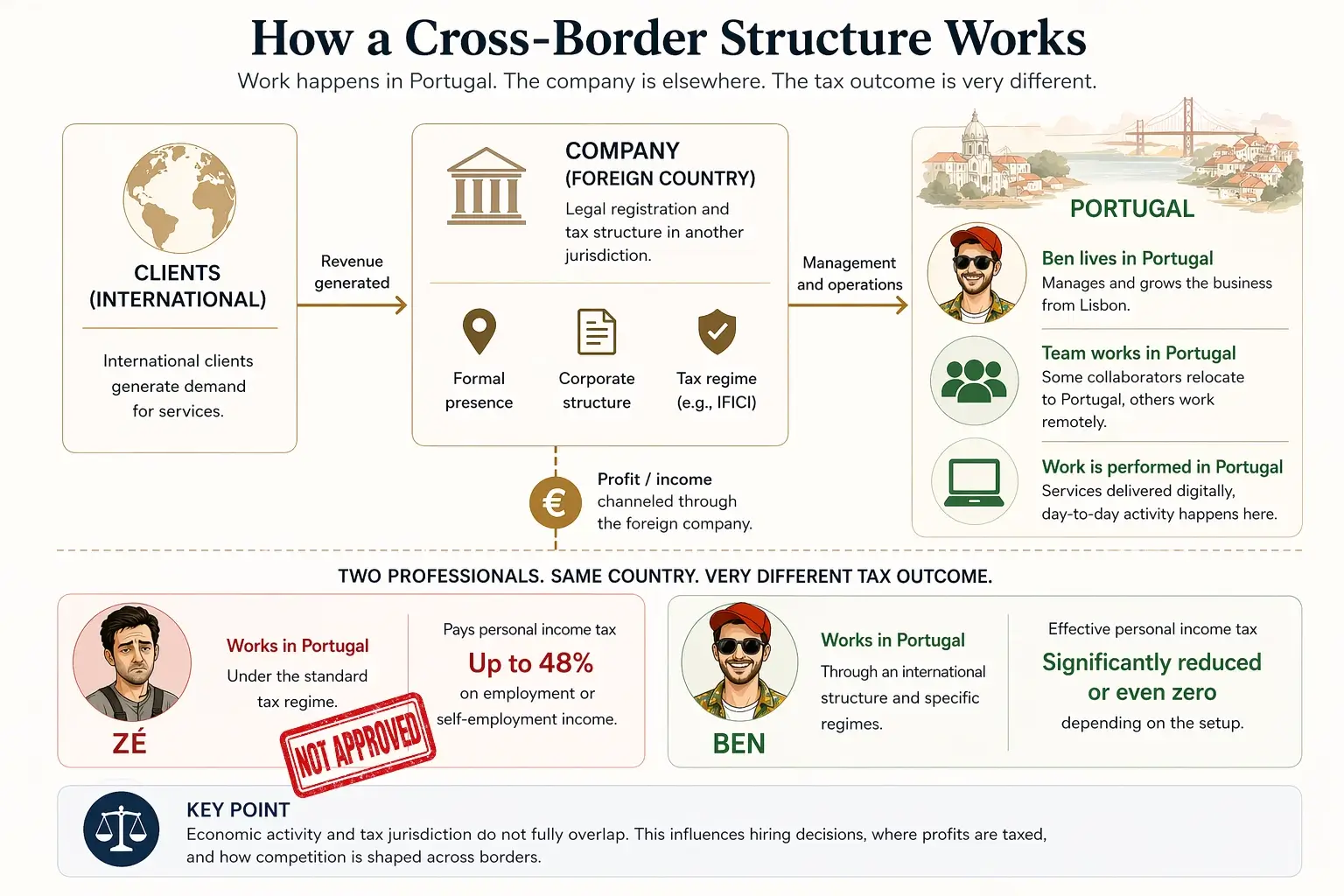
The central purpose of this publication is to make visible, even to readers without technical tax knowledge, the scale of the inequality created by these arrangements when compared with standard tax residents in Portugal, who may pay up to 48% Portuguese personal income tax (IRS) on the same work.
ℹ️ Clarification on the 48% tax rate
The 48% figure refers to Portugal’s top marginal IRS rate, not the effective tax rate applied to total income. Portugal uses a progressive tax system, meaning lower portions of income are taxed at lower rates. The comparison in this publication highlights the structural asymmetry between the general regime and situations where a flat 20% rate or exemption on certain foreign-source income may apply.
The EURES portal (European Employment Services) identifies the visual arts and audiovisual production sector — including film directors and producers, photographers, and audiovisual technicians — as an area with insufficient job offers and greater difficulty for candidates seeking work in Portugal.
There is a clear irony here: the former NHR 1.0 and the current TISRI (NHR 2.0 / IFICI) regime are promoted as tools to attract “talent”, yet by creating severe tax asymmetry and fiscally distorted competition, they can penalise the local professionals who already provide exactly the same services in Portugal, and may even push them out of the market.
If the policy objective is truly to benefit the sectors into which this talent is being drawn, why do official communications focus almost exclusively on research, science, and technology, while saying little or nothing about fields such as the arts and audiovisual production, which are also covered?
Meanwhile, indicative fee tables for audiovisual technicians — used for years as a market reference and contextualised in this sector manifesto — were investigated by the Portuguese Competition Authority in a process that culminated in a sanctioning decision in 2024. The association that published them was fined and required to remove them after the tables were considered a form of “price fixing”. Yet the TISRI (NHR 2.0 / IFICI) regime, written into the law itself, continues to permit a structural difference in taxation between new residents and professionals who have always worked in Portugal, creating fiscally distorted competition inside the same market.
This is not an isolated concern. A published opinion article (in Portuguese) has pointed to the regime’s wider effects on housing, cost of living, and market pressure, particularly when preferential tax treatment for new residents increases purchasing power in a country where local wages remain much lower.
This link between preferential taxation and the real estate market is also visible in the way the regime was circulated by actors within the sector itself. For example, a now-removed publication on the website of a Portuguese real estate agency specialising in the market for foreign buyers presented IFICI / NHR 2.0 as relevant information for foreigners considering residence in Portugal and making financial decisions in the country. The publication was dated 23 December 2024, the same day Ordinance No. 352/2024/1 was published, regulating the regime. Although the page reproduced information originally published by The Portugal News , its appearance on the agency’s own website shows how quickly the new tax benefit was treated as commercially relevant information for an audience of prospective international residents and property buyers. This does not, by itself, prove a direct impact on housing prices.
ℹ️ Important note on “0%” and the scope of this analysis
This publication starts from the personal income tax asymmetry, especially the contrast between 0%–20% for some new residents and up to 48% for tax residents under the general regime doing the same type of work. In later sections, the analysis also expands to company structures, social security contributions, business incentives and tax-framing mechanisms that may reinforce that advantage.
References to 0% scenarios are based on public information made available by tax advisers, business organisations and institutional materials — for example, publications by chambers of commerce. This content is analytical in nature and does not replace professional tax or legal advice.
In simple terms, IFICI is framed by Article 58-A of the Tax Benefits Statute, but the mechanism behind the exemptions on foreign income appears in Article 81 of the Portuguese Personal Income Tax Code. That is where the law provides that certain income obtained abroad may benefit from the exemption method in Portugal, while still being counted to calculate the rate applied to other income.
Even when certain foreign income benefits from a direct IRS exemption in Portugal, this does not mean that it disappears from a tax perspective. It may still have to be declared and, in some cases, may count when calculating the rate applied to other income. This is what is meant by progressivity or aggregation: the income may not pay IRS directly, but it may still be considered when calculating the IRS rate applied to the remaining income. Therefore, in this publication, “0%” should be understood as a reference to direct exemption on certain income — not as a complete absence of declaration, analysis or tax impact.
This is also not “zero tax” in an absolute sense. The exemption discussed here applies only to IRS. The new resident may still pay Social Security contributions on earned income and, where relevant, municipal property taxes such as IMT and IMI. In addition, structures such as holdings and EOR arrangements carry incorporation, maintenance, and compliance costs, and international tax positioning always requires specialised legal and tax advice.
Practical Example: A Director of Photography From Another Country Wants to Live in Portugal
Access to IFICI is not automatic: it depends on registration, qualification under eligible activities, confirmation of the applicable requirements and possible later verification. But once inside the regime, the exemption of certain income qualified as foreign-source appears to operate much more directly than under the former NHR regime.
According to available legal analyses, this exemption does not appear to require proof of effective taxation abroad. The central question is no longer whether the income paid tax abroad, but whether it can be qualified as obtained abroad — and how that qualification is accepted or challenged.
Ben arrives in Lisbon to begin a new chapter — with sun, opportunity, and a very particular tax regime.
Character: Ben, a Director of Photography from another country.
💼 See examples of covered professions and activities
The official lists of qualified positions and relevant economic activities show that the regime may cover a wide range of profiles and sectors, beyond the public narrative centred on science, research and innovation.
General directors and executive managers of companies
Administrative and commercial services directors
Production and specialised services directors
Hospitality, restaurant, retail and other services directors
Specialists in physical sciences, mathematics, engineering and related technical fields
Doctors
University and higher education professors
Finance and accounting specialists
Information and communication technology specialists
Film, theatre, television and radio directors, stage directors, producers and related directors
Intermediate science and engineering technicians and professions
Administrators, managers and general directors of eligible companies
The economic activities recognised as relevant also include areas such as accommodation, restaurants, education, human health, manufacturing, information and communication, consultancy, financial activities and insurance, among others.
Sources: Portuguese Tax Authority information leaflet on IFICI, Notice No. 4812/2025/2 / IAPMEI and Notice No. 5309/2025/2 / AICEP.
Objective: He wants to move to Lisbon and pay the minimum possible tax using the TISRI (NHR 2.0 / IFICI) regime.
Problem: He does not yet have foreign clients.
Solution: Consulting firms offer several legal “paths” to help him fit the regime.
The choice of this profession is not arbitrary: IAPMEI’s Notice No. 4812/2025/2 expressly lists, under code 2654, “film, theatre, television and radio directors, producers and related directors” as eligible for IFICI.
Importantly, the classification of activities — particularly those considered “high value-added” — is not always subject to prior validation and may be assessed later by the Tax Authority, sometimes years after the fact. This creates a layer of legal uncertainty where eligibility can depend on interpretation and be challenged retrospectively.
Path 1 — A Single-Shareholder Company in Portugal
Ben creates a Portuguese single-shareholder company.
He appoints himself manager or director, a role appearing on the list of eligible professions.
The consulting firm ensures that the company invoices more than 50% abroad; in practice, this may only require arranging some international contracts.
Result:
The management salary paid to Ben by the Portuguese single-shareholder company is Portuguese-source income and may benefit from the special 20% rate, regardless of whether the company’s clients are Portuguese or foreign.
Work for foreign clients is often commercially presented as potentially qualifying as foreign-source income and, in certain cases, benefiting from an IRS exemption in Portugal.
Note: Ben can come to Portugal with no clients and, once in Lisbon, begin by securing a few small assignments for foreign clients on his own. That can also count towards the condition that more than 50% of invoicing comes from abroad.
If the work is carried out from Portugal, even for foreign clients, the income will generally tend to be treated as Portuguese-source and therefore not automatically exempt.
What the Portuguese Tax Authority says
The Portuguese Tax Authority itself, in Circular Letter No. 20276/2025, dated 26 February, clarifies that the concept of "job position" referred to in subparagraphs a), b), d), f) and g) of paragraph 1 of Article 58-A of the Tax Benefits Statute " necessarily requires the existence of an employment contract". In practice, this means that a professional invoicing on their own as a service provider, without an employment contract, cannot access IFICI through the routes that depend on a "job position" — which is precisely why the single-shareholder company structure becomes central: it is through that company that the professional can formally become a member of a corporate body of a Portuguese entity, overcoming that formal limitation.
By creating a Portuguese single-shareholder company, Ben stops acting merely as a freelancer and starts offering services across the whole audiovisual field, functioning in practice like a production company capable of competing directly with local companies.
Direct Competition with Local Production Companies
In this position, Ben starts selling services like a genuine film and video production company. When he gets larger projects, he subcontracts local technicians — sound recordists, assistants, operators — and those costs become production costs borne by the company.
On paper, the tax framework makes it possible that:
Foreign clients: the income can be presented as foreign-source income and, in certain arrangements, come close to 0% IRS in Portugal, depending on where the service is effectively provided, on double taxation treaties, and on the Tax Authority’s acceptance.
Portuguese clients: the qualified work Ben provides may, in principle, be taxed at the special 20% rate under the TISRI (NHR 2.0 / IFICI) regime instead of the progressive rates that, for local professionals operating under standard personal taxation, can reach around 48%.
Impact: this tax margin allows Ben to offer substantially lower final prices, even while covering all production costs.
Result: a difference in tax burden is created that, in some scenarios, can amount to dozens of percentage points and which can function as a form of fiscal dumping in a market already weakened by the shortage of employment in Portugal’s audiovisual sector.
Path 2 — A Foreign Holding Company (for example, Malta)
The consulting firm creates a holding company in Malta.
That holding company opens a Portuguese subsidiary.
Ben employs himself in the Portuguese subsidiary and is taxed at 20% on salary.
Profits or dividends from the foreign holding may be paid to Ben with exemption in Portugal, provided treaty rules and economic substance rules are satisfied.
Result:
He satisfies the law formally by having a company, a qualified role, and residence.
But a large share of his income is turned into dividends that are not taxed in Portugal.
Creating and maintaining a holding structure in a country such as Malta may, in general, cost only a few thousand euros per year — registration, virtual office, accounting, company secretarial work, and similar overhead. Those amounts are within reach of many professionals operating under Portugal’s TISRI (NHR 2.0 / IFICI) regime who invoice tens of thousands of euros annually. It is therefore not merely an “exotic scheme for the elite”, but a standardised product that can become economically advantageous from income levels around €30,000 to €40,000, depending on the specific case.
Path 3 — Employer of Record (EOR)
Ben hires a consultant or EOR that creates an entity to “employ” him formally.
That entity invoices services abroad, even if the structure has been assembled specifically for that purpose.
Ben receives salary or fees framed under the TISRI (NHR 2.0 / IFICI) regime and is therefore taxed at 20% IRS.
If he sells his business or has passive income, the consultant may “repackage” those flows into investment products, bringing the effective rate down to 2%–7% in some cases, depending on structure and tax acceptance by the authorities.
Result:
He meets the formal requirements.
But in practice he is using the consultant’s structure in order to gain access to an exemption on foreign-source income.
This issue is not limited to self-employment income. In category A income, a salary paid by a foreign entity may also be presented as foreign-source income. If that income may be taxed in another state under the applicable tax treaty — without having to be effectively taxed there — and Portugal treats it as exempt under the TISRI (NHR 2.0 / IFICI) regime, practical double non-taxation may arise. The Portuguese Tax Authority may, however, challenge this treatment if the activity is effectively carried out from Portugal.
Beyond Employer of Record arrangements, similar outcomes can also be achieved through other structural approaches used in the market.
Crucially, these structural approaches are not merely theoretical. Guidance from leading Iberian law firms indicates that financial activities such as holding companies (under the CAE 6420 classification) may be considered relevant economic activities within the IFICI framework, provided that the applicable conditions are met.
In this context, such structures can be used to establish local economic presence while allowing certain categories of foreign-source income — including dividends — to benefit from exemption, depending on their qualification, applicable tax treaties, and acceptance by the Portuguese Tax Authority.
Path 4 — Already Having Foreign Clients
Example: Ben already works regularly for production companies in his home country and decides to move to Lisbon.
Tax residence: Ben becomes resident in Portugal and applies for TISRI (NHR 2.0 / IFICI) status.
Qualified activity: As a producer, director, or cinematographer, his profession can fit within the TISRI (NHR 2.0 / IFICI) regime as a qualified activity under Ordinance No. 352/2024/1.
Existing foreign clients: He continues to film in Portugal for production companies from his country of origin, invoicing them directly.
Tax declaration:
Although the clients are outside Portugal, Ben performs the work from Portugal. According to the IFICI guide from the Portuguese Order of Certified Accountants, such income is generally Portuguese-source income and is therefore taxed in Portugal under the TISRI (NHR 2.0 / IFICI) regime, not automatically taxed at 0% IRS.
The country of origin taxes only if, under the relevant double taxation treaty, it is allowed to do so — for example, if there is a permanent establishment in that country.
Result:
Work for Portuguese clients is taxed at 20% IRS.
Work for foreign clients may, in some forms of tax planning, come close to an effective burden of 0% IRS.
This type of planning may be presented without the need for a holding company or an EOR, simply by making use of clients Ben already had before moving — although the exemption always depends on the specific tax qualification of the income and may be challenged if the work is performed from Portugal.
In many of these commercial sales narratives, the idea offered to Ben is obvious: settle in Portugal, build foreign relationships and clients, provide them with services from here, and seek to frame that income as foreign-source income that may benefit from an exemption from IRS. These outcomes do not rely on isolated or exceptional configurations, but on combinations of rules that are explicitly embedded in the system.
Path 5 — Minimum Passive Income
Example: Ben has regular foreign passive income — interest, dividends, royalties, rents, or in certain cases gains from the sale of foreign financial assets — adding up to at least €920 per month — the equivalent of the Portuguese minimum wage, used here strictly as an illustrative benchmark.
Tax residence: Ben becomes resident in Portugal and applies for TISRI (NHR 2.0 / IFICI) status.
Qualified activity: A producer, director, or cinematographer may fit within the TISRI (NHR 2.0 / IFICI) regime as a qualified activity under Ordinance No. 352/2024/1. In addition, if Ben receives passive income from foreign sources — such as interest, dividends, royalties, or property rents — such income may, in certain cases, benefit from exemption in Portugal, although each type of income has its own rules and may also be subject to withholding tax in the country of origin. In practice, the tax treatment of certain foreign capital gains may depend on the timing of tax residence, particularly when assets are disposed of after establishing residence in Portugal under the applicable regime. The €920 monthly figure is used here only as an illustrative benchmark for means of subsistence, not as a formal legal requirement.
Continuing to work: Ben continues to work in Portugal as a director or cinematographer. The services he provides, even to foreign clients, are generally taxed in Portugal, though he may benefit from the 20% rate under the TISRI (NHR 2.0 / IFICI) regime if it applies.
Tax declaration:
After entering the regime through his passive income profile, Ben continues to work from Portugal. Even with foreign clients, that labour income is generally considered obtained in Portugal and taxed here, though it may benefit from the 20% rate.
More aggressive tax planning may attempt to build foreign structures in order to reclassify part of that work as foreign-source income and obtain exemption.
Result:
Work for Portuguese clients, and foreign work physically carried out from Portugal, is taxed at 20% IRS.
Foreign passive income may, in some cases, be exempt from IRS in Portugal.
This can happen without any holding company or EOR arrangement, simply through passive income Ben already had outside Portugal.
Comparative Table
Path
What Ben does
How it formally fits the law
What he pays
How it works in practice
Single-shareholder company in Portugal
Creates his own company
Eligible role + activity recognized as relevant (subpara. d), or 50%+ foreign invoicing (subpara. c, ii)
20% in Portugal; abroad may, in some cases, come close to 0%
Declares work for foreign clients as “foreign-source income”
Holding company in Malta
Creates a parent company abroad plus a Portuguese subsidiary
Employment in a qualified role
20% on salary; dividends may, in some cases, be exempt
Profits are distributed as exempt dividends
Employer of Record (EOR)
A consultant creates an entity that employs him
Exporting company + qualified role
20% on salary; investment-packaged income may, in some cases, be taxed at 2%–7%
Passive income is repackaged into investment products
Already having foreign clients
Continues invoicing clients from his home country
Qualified profession + residence
20% in Portugal; abroad may, in some cases, come close to 0%
Frames international invoicing as “foreign-source income”
Minimum passive income
Proves regular foreign passive income of at least €920/month
Residence + qualified profession
20% in Portugal and, in some cases, close to 0% abroad, including eligible foreign passive income
Uses passive income as a base of subsistence combined with the TISRI (NHR 2.0 / IFICI) regime
Conclusion.
Anyone who already has foreign clients only needs to fit within the TISRI (NHR 2.0 / IFICI) framework; the tax benefit can apply immediately.
Anyone who does not have such clients turns to consultants to build structures — single-shareholder companies, holdings, or EOR arrangements — that simulate or generate international invoicing.
Anyone with foreign passive income may, in some cases, benefit from IRS exemption under the TISRI (NHR 2.0 / IFICI) regime, provided they are already framed through a qualified activity and tax residence.
In many cases, the desired effect converges towards a similar outcome: a 20% rate in Portugal combined with reduced or, in some structures, near-zero taxation on certain foreign-source income, depending on legal qualification and treaty interpretation.
IFICI is not fraud, but it is an invitation to inequality — flavoured with pastel de nata and 0% IRS.
The Tax Engineering IFICI Makes Possible
How formal requirements, documentation, corporate structures and international flows can become a fiscal architecture that ordinary residents can hardly replicate.
This section does not claim that these structures are widely used, nor that every arrangement of this kind is illegal.
The central point is something else.
The regime creates interpretative grey areas where consultancies, tax lawyers and international providers may attempt to turn formal requirements into fiscal architecture.
There is an entire professional economy dedicated to exploring, optimising, structuring and defending the possibilities opened by the regime.
An international regime explained almost exclusively by private intermediaries. Although the IFICI is promoted internationally to attract foreign residents, the legislation, the official notices and the mechanisms for practical interpretation remain largely available only in Portuguese. Foreign nationals who have contacted IAPMEI seeking clarification on the regime have received, among others, this reply: "We apologize, but we do not have the legislation in English."
This creates a practical dependence on consultancies, law firms and specialised intermediaries to interpret, structure and access a regime that was designed precisely to attract new international residents — yet whose official documentation remains inaccessible to those who do not speak Portuguese.
ℹ️ European policy context on harmful tax practices
A European Parliament study on harmful tax practices within the European Union does not analyse IFICI specifically, but it provides a useful framework for understanding why regimes of this kind deserve scrutiny. The study identifies several models that may lead to harmful tax competition when structured in a way that distorts the normal allocation of resources within the Single Market — including foreign-source income exemption regimes, shell companies, special economic zones and preferential tax rulings.
These measures are not necessarily illegal in themselves. They become problematic when they produce selective tax advantages, double non-taxation, or outcomes disconnected from real economic activity. IFICI is not analysed in that study, but the combination of foreign-source income exemptions, holdings, EOR arrangements, international structures and benefits reserved for new residents presents characteristics that coincide with risk categories of harmful tax competition identified in the study.
This analysis is not based on identified individual cases, but on the cross-reading of legislation, official notices, technical guidance, consultancy publications, legal analysis and publicly available market patterns. The objective is not to accuse specific beneficiaries, but to show how the architecture of the regime can be interpreted, marketed and structured.
When the difference between the standard regime and IFICI can mean dozens of percentage points in tax, this is no longer an academic issue. There is a clear economic incentive to test the limits of the law: classify roles as strategic, present holding companies as active management structures, distinguish artificially between Portuguese-source and foreign-source income, or organise income flows through intermediary entities.
Even if the Portuguese Tax Authority may challenge some of these arrangements later, the political problem remains: the regime shifts part of the scrutiny to after the fact, while the economic benefit may be captured from the beginning by those with access to specialised advice.
IFICI creates a significant temporal asymmetry: the tax benefit can be obtained from the outset, while full verification of economic substance, the main activity, and the actual eligibility of the structure may occur only later. For some beneficiaries, this transforms the regime into an immediate benefit subject to potential future reinterpretation; for the market, however, the effects on prices, margins, hiring, and competition can materialize long before any tax adjustment takes place.
Holding companies, head offices and active management
One of the least discussed aspects of IFICI is that the regime is not limited to laboratories, universities, scientific research or advanced technology. The official framework also recognises certain financial, insurance, consultancy and business management activities as relevant to the national economy.
Among the listed activities are CAE classes 6420, associated with holding companies, and 7010, associated with head office activities — including the supervision and management of other units of the group in the areas of strategic and organisational planning. At the same time, qualified positions include administrators, managers, managing directors and executive managers.
In practice, this means that a new resident may not need to be a researcher, scientist or engineer to access the regime. It may be enough to perform a qualified role or sit on the governing body of a qualifying entity, provided the formal requirements are met and accepted by the competent authorities.
This is where the line between an innovation incentive and aggressive tax planning becomes politically relevant. A merely passive holding company would be difficult to justify under the regime — but a structure that provides management, coordination or direction services to its subsidiaries may present itself as a qualifying economic activity, creating a bridge between tax residence in Portugal, administrative functions and income structured through corporate entities.
The distinction matters precisely because eligibility depends on formal framing, functional description, main activity, contracts, documentation and later interpretation. The question is no longer only “what does this company actually do?” but also “how is that activity described, documented and presented to the competent authorities?”. That difference may be legitimate in some cases; in others, it can become a way of moving an aggressive tax planning structure closer to a benefit publicly presented as supporting innovation and value creation.
The political problem lies in that boundary. If access to the benefit depends heavily on how the activity is organised and described, then those able to pay for specialised consultants gain an additional advantage: not only a tax advantage, but an interpretative one.
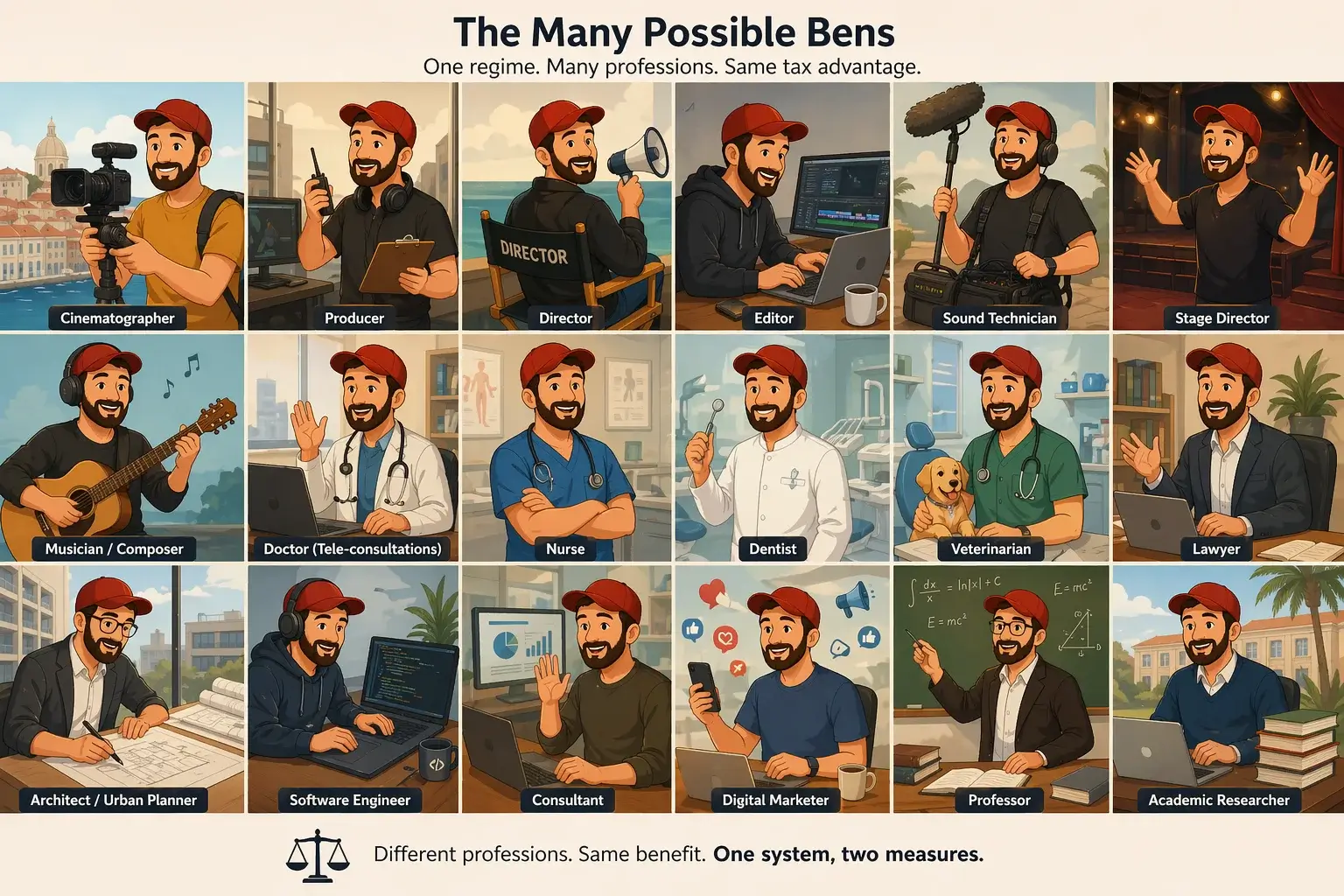
The many faces of the tax advantage
The example of Ben as a director of photography is only a narrative entry point. The broader problem is that the regime may accommodate very different profiles, provided they can be framed within one of the formal or interpretable categories available under it.
1. Creative Ben
A film director, producer, cinematographer or audiovisual professional with international clients, presented as a qualified activity or an exporter of services.
2. Academic Ben
A PhD holder, researcher, lecturer or technical specialist whose academic profile can reinforce the narrative of research, innovation or high added value.
3. Founder Ben
A founder, administrator or member of the governing body of a certified startup, using the innovation narrative to access the regime.
4. Manager Ben
An administrator, manager or director of a qualifying company, including management structures, head offices or holding companies presented as active entities.
This diversity matters politically. The more profiles can fit into the regime, the weaker the public narrative becomes that IFICI is merely a narrow incentive for scientific research and innovation. And the more qualified, internationalised and advised the beneficiary is, the greater the ability to combine those doors into a highly optimised fiscal arrangement.
When tax optimisation becomes a product
The pattern that emerges from these interpretations is consistent: IFICI does not merely reduce tax rates — it creates a grammar of classification. The same economic reality can be reorganised through different labels (startup, head office, shared services centre, exporting company, active management holding, qualified researcher, administrator, specialised technician) and recombined into fiscal narratives ready to be sold as a structurable product, not merely as a public policy for innovation.
It is this elasticity that makes IFICI particularly attractive to consultants and tax lawyers. The product being sold is not merely a 20% rate or a possible exemption on foreign-source income. It is the ability to redesign the taxpayer’s fiscal story so that it fits one of the available doors.
It is in how easily market language turns the regime into pathways, vehicles, structures, economic substance, management contracts and competitive advantages. Public policy promises innovation; the commercial ecosystem quickly learns to sell it as tax positioning.
The problem is not that all these pathways are necessarily illegal. The problem is that the distance between real economic activity and an optimised fiscal narrative can become small enough to be turned into a professional service. This is where IFICI stops being merely a tax benefit to attract talent and starts functioning as a platform for fiscal design: those with access to the right consultants do not merely declare their activity — they learn how to frame it.
A documented case study
A particularly revealing example can be found in a public account published by a Portuguese law firm concerning the creation of a venture builder. According to the firm’s own description, after the end of the former NHR regime it examined the new IFICI qualification routes and identified membership of the governing body of an active certified startup as a possible pathway for expatriate clients.
According to the published explanation, participating clients contribute capital, professional experience and contacts, join the company’s governing body and use that position as the basis for applying to IFICI. The firm later publicly stated that approximately 50 of its IFICI clients had been approved.
The unusual feature is the integration of the entire pathway.
The legal adviser, the qualifying entity, the investment opportunity, the governing-body position and the IFICI application appear to form part of the same commercially organised ecosystem.
This does not, by itself, demonstrate illegality, the absence of genuine business activity or that the participants perform merely nominal functions. It does, however, show how access to eligibility can itself become part of a structured professional service: a client seeking the tax regime is introduced to an entity created within the adviser’s ecosystem, invests in it, assumes a potentially qualifying position and is then assisted by the same adviser in obtaining registration.
The publicly available information does not make it possible to determine how much each participant invests, which amounts correspond to investment or professional fees, how members of the governing body are selected, what individual responsibilities they assume, how much time they devote to the company or whether those positions would exist independently of IFICI.
The public presentation of this venture builder also provides limited evidence from which to assess the scale and maturity of its activities. Its website consists essentially of a single institutional page listing seven portfolio projects. Only two link to external websites, and both are classified as investments rather than ventures developed internally by the studio. The remaining projects have no dedicated pages, identified teams, public product demonstrations or independently verifiable operating indicators.
This limited public information does not prove that the projects lack genuine activity. It does, however, prevent an independent assessment of their maturity, economic substance, measurable results and the individual contribution made by the governing-body members whose positions support IFICI applications.
This example concerns one particular pathway — investment combined with participation in the governing body of a certified startup. More broadly, when the different pieces of IFICI structuring are assembled, the architecture can take a recognisable shape: a formal entity in Portugal, an eligible activity, documented economic substance, organised international invoicing, separated salary and dividends, and foreign income framed within an exempt category.
1. The vehicle
A Portuguese company, head office, holding company, startup or production entity is used as the formal structure through which the activity is framed.
2. The narrative
The activity is described as innovation, active management, research, export of services, curation, qualified production or a high added-value function.
3. The substance
Contracts, coworking arrangements, minutes, reports, emails and functional descriptions, among others, are used to try to demonstrate that the structure has presence and real activity.
4. The extraction
Economic income can be divided between salary, dividends, capital income, foreign entities and international flows, seeking to reduce income tax and contributions.
This is one of the hardest aspects to explain to the public, but also one of the most important: the problem is not only the money that comes in, but the fiscal label under which it enters. The same economic reality can be presented as work, management, investment, dividend, intellectual property or foreign income, depending on the structure built around the beneficiary.
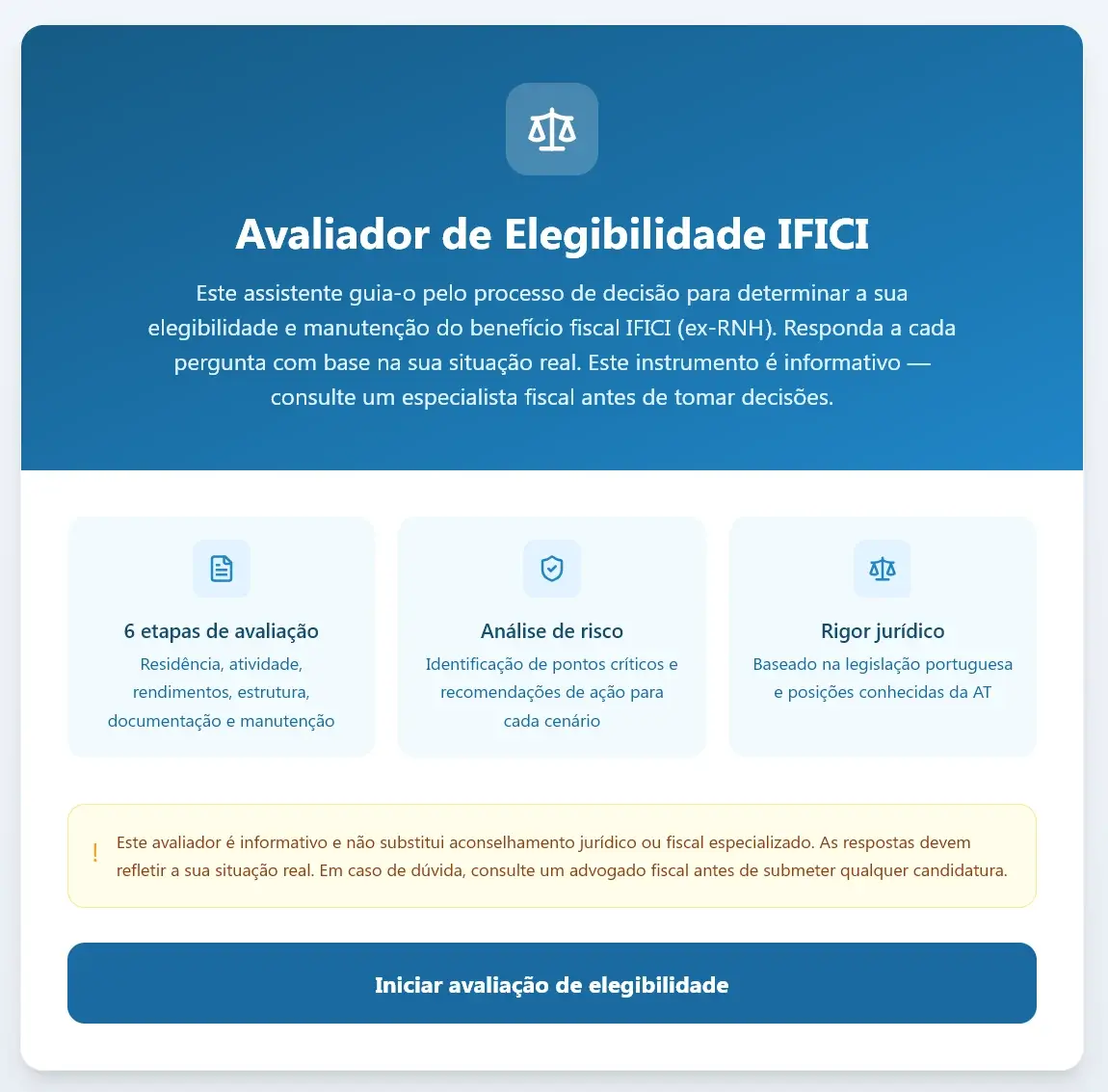
Interactive editorial simulator about the decision path commercially presented around IFICI. Currently available in Portuguese. Click the image to open the tool.
The problem is not one isolated piece.
It is the whole: when vehicle, narrative, documentary substance and international flows combine, the regime may stop functioning merely as an innovation incentive and start operating as an architecture of fiscal invisibility.
This reading does not require claiming that all beneficiaries abuse the regime. It is enough to recognise that the law creates a sequence of formal doors that can be organised by specialised consultants to produce a fiscal and contributory burden that most ordinary residents can never replicate.
Economic substance or documentary theatre?
One of the most sensitive areas of this kind of planning is so-called economic substance. In theory, a legitimate structure must demonstrate real activity, decision-making capacity, adequate resources, effective management and an economic link to the territory. In practice, however, the boundary may depend on documents: contracts, minutes, reports, emails, proof of physical premises, functional descriptions and files prepared to withstand a possible tax inspection.
This is where the critique of the regime becomes more concrete. A merely passive holding company may be difficult to justify. But a holding company presented as an active management centre, with a coworking contract, decision minutes, consultancy services, intra-group invoicing and periodic reports, may attempt to build the appearance of sufficient operational activity to defend the arrangement.
The same applies to the export requirement. When a Portuguese company invoices management, consultancy or production services to foreign entities related to the beneficiary himself, the issue is no longer only tax-related: it also involves transfer pricing, economic justification for the amounts charged and proof that the services were actually provided under conditions comparable to the market.
This is the critical point: the greater the tax advantage, the greater the incentive to produce the documentation that makes the structure defensible. Economic substance then stops being merely a business reality and also becomes a documentary construction.
The question is no longer only “is there real activity?”.
It also becomes: what activity was described, what contracts were drafted, what minutes were produced, what prices were justified and what narrative was prepared to convince the competent authorities?
The greater risk is performative compliance.
When the focus shifts to preserving traces of presence, producing minutes, preparing reports, justifying prices, organising emails and building documentation to withstand a future inspection, the boundary between real activity and documentary staging becomes politically impossible to ignore.
The problem becomes even more serious when the strategy is no longer only to meet requirements, but to manage risk signals: avoiding inconsistencies between declared income and lifestyle, deciding when to request or avoid refunds, preparing annual activity reports, organising evidence of physical presence and building a documentary narrative before any audit takes place.
In creative, scientific or intellectual sectors, this boundary becomes even harder to audit, because the value of the work can be described as research, curation, strategy, artistic direction, qualified production or highly specialised technical merit.
At that point, substance is no longer only what the company actually does. It also becomes what it can prove, archive, report and stage through documentation.
None of this means that all these structures are false or abusive. But it shows how a regime with significant benefits, broad categories and documentary validation can create an industry of framing: not only to comply with the law, but to build the version of reality that best fits it.
From fiscal dumping to contributory dumping
The public discussion around IFICI tends to focus on personal income tax: 20% on certain qualifying income and possible exemption on certain categories of foreign-source income. But tax engineering around the regime can operate on two additional layers: social security contributions and the international routing of income.
1. Low salary, high dividends: contributory dumping
The logic: maintain a formal remuneration subject to income tax and social security contributions, while a substantial part of the economic income is extracted through dividends, profits or capital income.
The effect: the advantage is no longer only a lower income tax rate. It may also reduce the effective participation in the financing of Social Security.
The risk: if the formal remuneration is artificially low compared with the real functions performed, the structure may be challenged by the authorities.
The logic: income that would not directly benefit from exemption because it comes from sensitive jurisdictions may try to circulate through intermediary entities in non-listed countries.
The effect: the income arrives with a fiscal appearance that differs from its real economic origin.
The risk: CFC rules, anti-abuse clauses, beneficial ownership, economic substance and transfer pricing may lead the Portuguese Tax Authority to disregard the structure.
The advantage is not only in paying less personal income tax.
It is in the ability to separate salary, dividends, capital income, social contributions, jurisdiction of origin and paying entity — an architecture that the ordinary local worker can rarely replicate.
This is why the critique of IFICI cannot be limited to the 20% rate. The regime becomes politically explosive when it allows a reduced rate on qualified work to be combined with exemptions on foreign income, corporate structures, dividends, intermediary entities and reduced social contributions.
And there is a layer above this one. IFICI does not exist in isolation: a sophisticated beneficiary may stack the personal income tax regime with corporate tax incentives such as SIFIDE (R&D deductions), sectoral support schemes such as the audiovisual cash rebate, and differentiated treatments for salary, dividends, profit-sharing, royalties and copyright income — each legitimate on its own, but cumulatively powerful.
The problem is not the isolated existence of each incentive.
The problem is the cumulative effect: when personal, corporate, sectoral and contributory benefits can be combined, the advantage stops being merely fiscal and becomes systemic.
This accumulation does not, in itself, imply illegality. Many of these instruments have legitimate goals: attracting investment, supporting audiovisual production, encouraging research or rewarding productivity. The political question is who has the capacity to combine them, for what purpose, and what kind of competition this creates against local professionals and companies operating without the same fiscal and advisory architecture. When the effective tax, contributory and financial burden can be reduced through multiple channels at the same time, competition no longer depends only on talent, price or quality: it also depends on the ability to structure, finance and absorb margins differently from local competitors.
The checklist reveals the problem.
What looks complex when described legally becomes simple when organised as a process: create the vehicle, choose the framing, produce substance, structure remuneration, justify prices, monitor ratios and prepare documentation. The political issue is precisely that: when fiscal inequality can be turned into a consultancy checklist, it stops looking like an exception and starts functioning as a product.
There is an essential distinction underlying everything above: IFICI is not an accidental flaw in the system. The 20% rate, the exemption of certain foreign-source income and the openness to management activities, head offices, holding companies, startups, research and qualified roles are part of the political design of the regime.
The declared objective is to make Portugal competitive in the international race for talent, investment and highly mobile residents. In that sense, the legislator accepts a trade-off: giving up part of normal taxation in exchange for the promise of attracting people, capital, consumption, companies and economic activity.
The problem begins when this logic of fiscal competitiveness becomes broad enough to accommodate structures whose main value lies not in innovation created in Portugal, but in the ability to organise income, functions, companies and documents in a tax-efficient way.
The political question is not only whether there is abuse.
It is why the law creates a regime where the boundary between legitimate incentive, aggressive planning and structural inequality so often depends on interpretation, documentation and the ability to pay for specialised advice.
In this sense, the critique of IFICI is not only moral or fiscal. It is a critique of the model of competition between states: countries compete for mobile residents by offering preferential regimes, while ordinary residents remain inside the general system that funds public services, Social Security and collective life.
The critical point is not that a holding company is automatically eligible.
The critical point is that the regime contains formal pathways through which holding, management and administrative structures can be brought closer to a tax benefit publicly sold as science, research and innovation.
The inversion is this: the law's stated objective is to attract talent, research and innovation. In practice, however, the regime also creates a market for those with enough capital to pay lawyers and consultants capable of designing structures suited to the tax benefit. Situations arise in which what is sold is not talent but structure. And it is the structure that captures a meaningful share of the fiscal rent released by the regime.
The LX Launch model provides a concrete public illustration of this concern: the taxpayer does not necessarily arrive with a pre-existing qualifying position. The adviser’s ecosystem may itself provide the entity, the investment route, the governing-body role and the professional assistance required to submit the IFICI application.
The result is a self-sustaining ecosystem: the regime breeds complexity; complexity breeds technical dependence; technical dependence breeds premium services; premium services breed structuring; structuring breeds risk; and risk breeds more advisory work, amended tax returns and litigation.
For a concrete illustration of how the regime is presented by the legal sector itself as a corporate restructuring exercise rather than a mere individual tax incentive, see “The C-Suite Migration to Portugal: Why IFICI is a Strategy, Not Just a Tax Break”, published by LVP Advogados.
Living in Portugal while earning passive income from abroad — potentially with little or no Portuguese personal income tax.
Living in Portugal on Foreign Passive Income
Ben receives passive income, such as rent from a property in his home country, amounting to at least one Portuguese minimum wage (€920 in 2026). He lives in Portugal and is covered by the NHR 2.0 / IFICI regime.
Ben does not work and still has access to the social safety net and to public services financed by the taxes — IRS, VAT, and others — paid by standard tax residents, while his own contribution to IRS may be 0%.
The central issue is not consumption or property taxes, but the absence of income tax — the core of the Portuguese tax system and its progressive structure.
In its real‑world application, the regime mainly attracts qualified residents or individuals with financial means, and it does not include any mechanism for annual verification of activity.
In theory, IFICI requires the beneficiary to continue performing a qualifying activity in order to maintain the regime. In practice, there does not appear to be any automatic annual verification of that activity through the tax return process, meaning that foreign passive income may continue to be declared as exempt while the status remains active, unless reviewed by the Portuguese Tax Authority.
Reminder: consult a tax specialist; this text does not replace professional advice.
Housing Pressure and the Ben–Zé Divide
The Ben–Zé contrast does not end with income tax. It extends directly into the cost of living — particularly housing, where Portugal has experienced one of the most aggressive price increases in Europe over the last decade.
Ben arrives under a preferential tax framework. In some cases, he may retain a significantly higher share of his income than a standard tax resident doing the same work. Zé, by contrast, remains subject to the ordinary tax system while facing the same rents, the same property market, and the same daily costs. The result is not just fiscal asymmetry, but unequal purchasing power inside the same city.
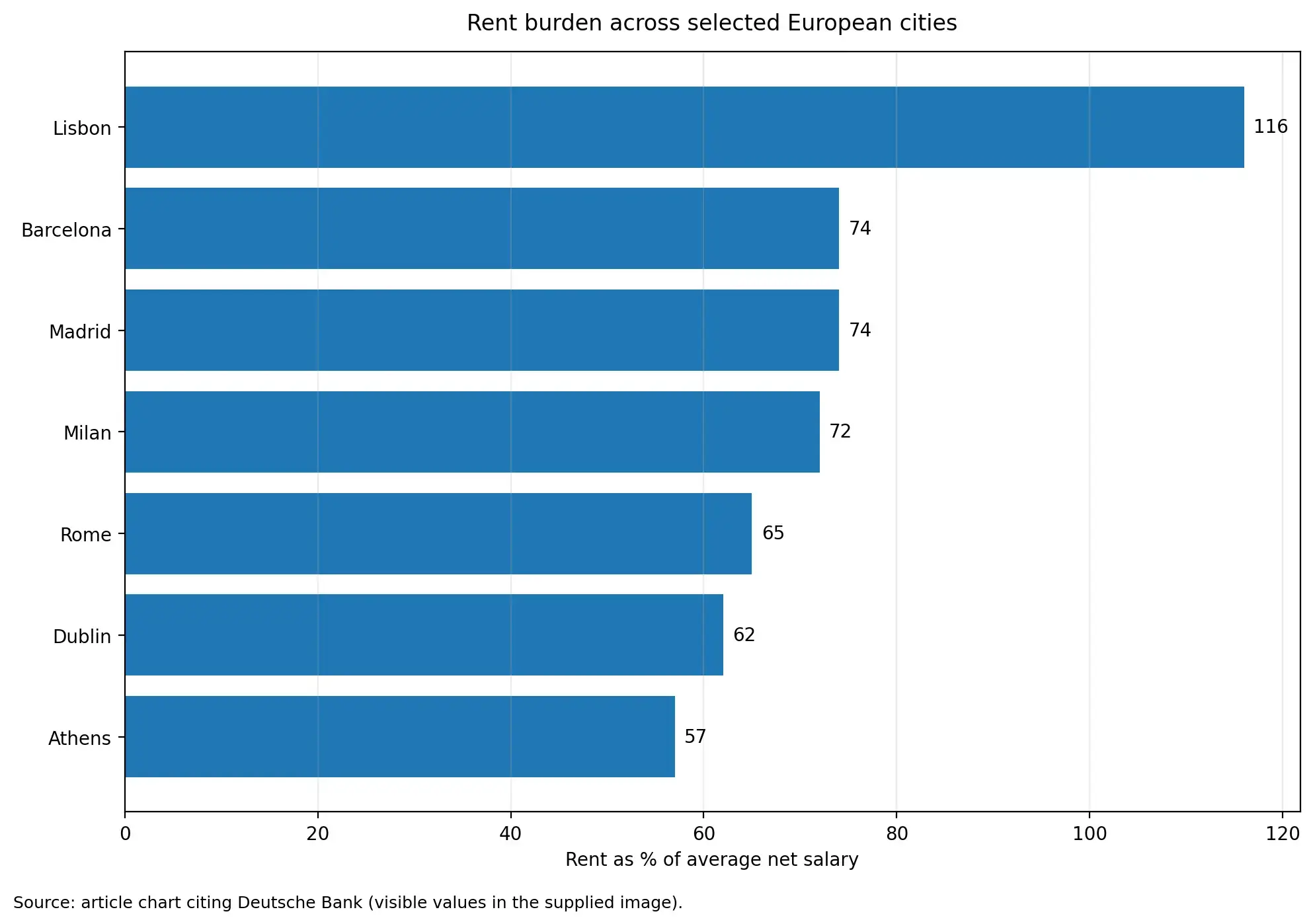
Lisbon stands out as one of the most extreme cases in Europe, with rent levels reaching or exceeding 100% of average income. Source: Deutsche Bank (via published analysis).
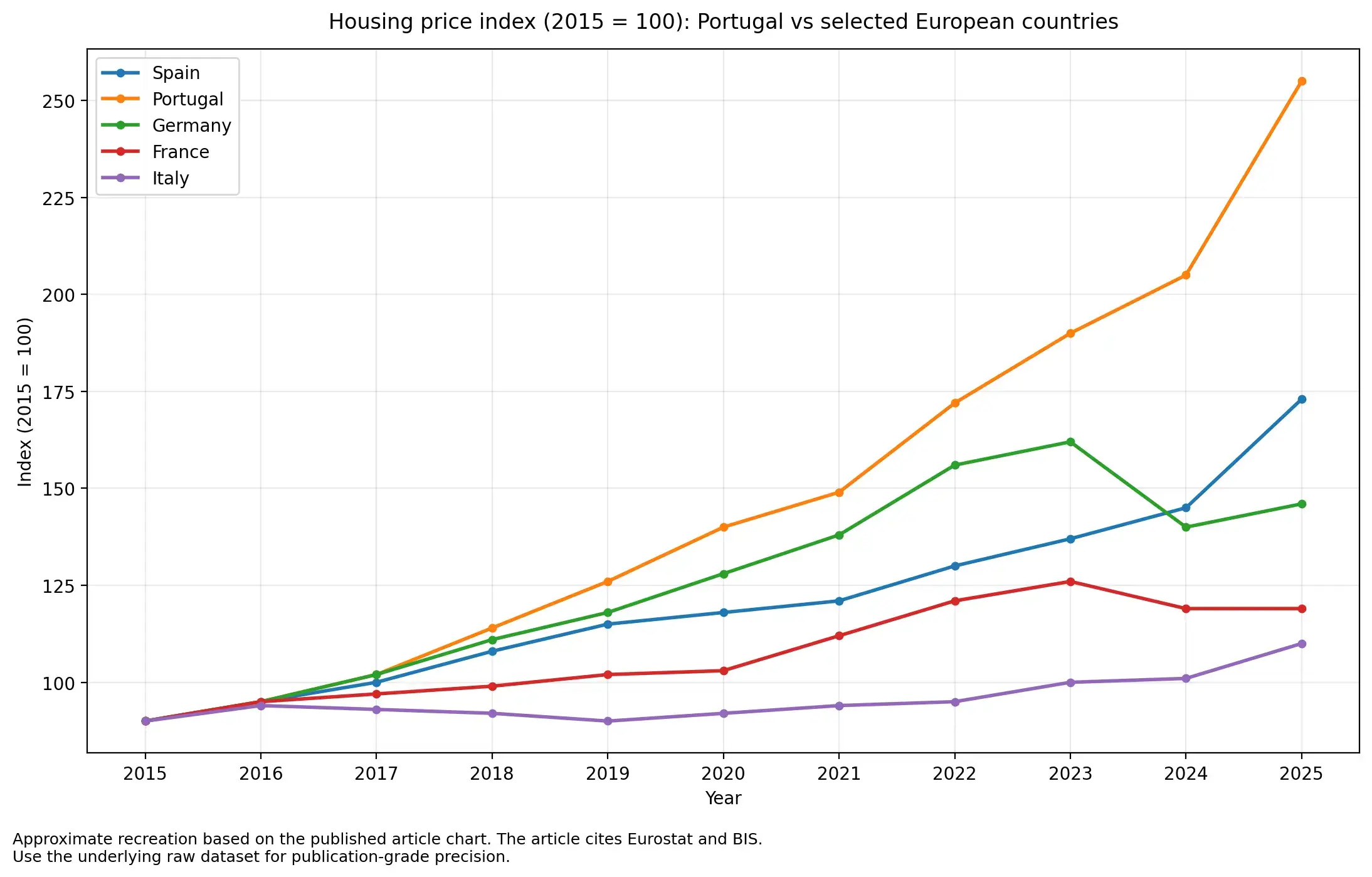
At the same time, housing prices in Portugal have risen faster than in comparable European economies. While the European Union has seen significant increases, Portugal shows a clear divergence, with price growth outpacing countries such as Spain over the same period.
Portugal has experienced one of the steepest housing price increases in Europe since 2015. Approximate editorial recreation based on published data (Eurostat / BIS framework).
In this context, even a relatively modest tax advantage can have outsized effects. If Ben retains more net income than Zé, he can absorb higher rents, compete more aggressively for housing, and remain in central urban areas. Zé, meanwhile, is squeezed from both sides: higher taxation on one side, rising housing costs on the other.
This is not driven by a single cause. Housing inflation is driven by multiple factors, including supply constraints, tourism, global capital flows, and investment dynamics. However, when a tax regime selectively increases the purchasing power of some residents in already constrained urban markets, it may amplify existing pressures.
In that sense, the Ben–Zé divide is not only fiscal. It becomes spatial: a question of who can still afford to remain in Lisbon, and who is gradually priced out while competing under less favourable conditions.
For years, several real estate stakeholders argued that regimes such as NHR had no meaningful impact on housing prices in Portugal. However, when the end of the regime was announced, some of those same actors began warning about a potential drop in foreign demand and a possible stabilisation of prices.
This shift in narrative implicitly suggests that the regime may, in fact, have contributed to pressure on the housing market — not as a single cause, but as an additional factor within a context already shaped by supply constraints, tourism, and international capital flows.
This tension between public messaging and market reaction reflects a broader challenge in assessing the real impact of such regimes: while their effects may be difficult to isolate, their influence becomes more visible when they are removed.
A Contradiction That Is Hard to Ignore
From a tax law perspective, this raises questions related to the principle of ability to pay and fiscal equality. When individuals operating in the same market are subject to substantially different effective tax rates based on formal eligibility criteria, the outcome may conflict with the idea that taxation should reflect comparable economic capacity. The existence of international tax competition helps explain why such regimes are implemented, but does not in itself resolve the question of their fairness within the domestic system.
In theoretical terms, such regimes may generate broad gains when adopted unilaterally. However, in a context where multiple countries apply similar policies simultaneously, the overall effect may be to reduce redistributive capacity and concentrate gains among highly mobile, high-income individuals.
Part of this contradiction also stems from the interpretive nature of the regime itself. While the legal framework defines formal eligibility criteria, its application — particularly regarding the qualification of income and cross-border situations — has been subject to differing interpretations between the Tax Authority and the courts, creating uncertainty and room for divergent outcomes in practice.
If the work is physically done in Portugal, why is the tax logic not the same for everyone?
If the relevant criterion were the place where the work is actually performed, the Portuguese Tax Authority would have to apply the same logic to everyone: to the Portuguese director who has always lived in Lisbon and to Ben, the “new digital nomad”, sitting at a café table editing videos for a client in New York. In both cases, the work is carried out in Portugal.
And yet the TISRI (NHR 2.0 / IFICI) regime opens an exception precisely for certain Bens, allowing a large part of that income to be treated as “foreign-source” and therefore potentially exempt from IRS, while standard tax residents remain under normal taxation. Either the income is Portuguese for everyone, or it is foreign for everyone. Anything else amounts to discrimination built into the law itself.
The use of foreign intermediary companies only makes the whole arrangement more artificial. In practice, it can work like this: the client is Portuguese, the work is done in Portugal, but the invoice comes from a foreign company for which Ben “works” — whether that company is a producer or a holding in a place such as Malta. That foreign company invoices Ben’s client and then pays Ben. In the end, the entire income appears to come from abroad even though the work never left Lisbon.
As for content-based distinctions, there is no clear and objective legal criterion capable of saying: “up to this point it is documentary; beyond that it becomes advertising or corporate video.” In substance, it is all audiovisual production within the same professional family.
International Work and the “Loophole”
For many freelancers and local production companies providing the same services as Ben, international work is one of the main sources of income and growth. When the TISRI (NHR 2.0 / IFICI) regime gives a far greater tax advantage only to newly arrived qualified residents, it creates unequal competition exactly in the space where domestic talent has been trying to grow.
Moreover, competition for the same clients does not stop at the international market: Ben can use this tax advantage to offer lower prices to Portuguese clients too, gaining an advantage in both markets.
In this example, by not being taxed in the client’s country — being treated there as a non-resident under the relevant treaty, perhaps by means of forms such as the W-8BEN — and by being exempt in Portugal under the TISRI (NHR 2.0 / IFICI) regime, Ben can reach situations approaching double non-taxation.
A concrete precedent
This tension is not merely theoretical. Under the original NHR regime, the combination of Portuguese domestic rules and international tax treaties led to cases of double non-taxation controversial enough to trigger reactions from other States. The tax treaty between Portugal and Finland ceased to apply from 1 January 2019, after unilateral termination by Finland; the tax treaty between Portugal and Sweden ceased to apply from 1 January 2022, after unilateral termination by Sweden. Although those cases relate to the former NHR regime and mainly to the treatment of pensions, they show that this type of asymmetry can have real political consequences beyond Portugal.
The loophole sold commercially is the following: some consultants suggest that Portugal may exempt this income even when the client’s country does not in fact tax it. Yet the IFICI Guide of the Portuguese Order of Certified Accountants states that, as a rule, exemption for category B requires a fixed installation or permanent establishment abroad under the TISRI (NHR 2.0 / IFICI) framework.
Put differently, the interpretation is that there may be IRS exemption provided that the income could have been taxed in the country of origin, even if it was not actually taxed there. Or, failing a double taxation treaty, provided that the income is not considered obtained in Portuguese territory. Proof that tax was effectively paid abroad is not required.
The loophole results from three legal pieces fitting together:
the double taxation treaty between Portugal and the country of Ben’s client;
the absence of a permanent establishment for Ben in the client’s country;
the IFICI / NHR 2.0 status and the exemption method in Portugal for income considered “foreign-source”, framed under the TISRI (NHR 2.0 / IFICI) regime.
Portugal has signed treaties of this kind with 79 countries, so this is not an isolated possibility but an opening available across multiple jurisdictions.
The key point is that, for TISRI / IFICI / NHR 2.0 purposes, the benefit on so-called foreign-source income does not result from a coherent application of the domestic rule based on where the work is physically performed. It results instead from the interpretive reading of the relevant double taxation treaty. In practice, that choice of criterion is what makes it possible to treat as “foreign” income generated by work physically done in Portugal.
As the saying goes: “Go abroad without leaving home.”
Tourism of Portugal slogan (1990s)
And Inside Portugal?
The injustice does not disappear on the domestic side.
Imagine a purely domestic law saying: “Professionals who have worked in Lisbon during the past five years pay IRS at normal rates; professionals coming from Porto always pay a flat 20%.” The difference would be “only” eight or ten percentage points. Would anyone consider that acceptable, or would it immediately be seen as a blatant violation of equality?
Imagine a similar example for passive income. It would be as if the law said that a professional from Porto, after moving to Lisbon, would stop paying IRS on the rent from their house in Porto simply because they are now a “new resident” in the capital, while a person who has always lived in Lisbon would continue paying tax on identical rental income. Anyone would recognise that as an inequality that is hard to justify.
Why do we accept discrimination more easily when the criterion becomes “new resident” versus “standard tax resident”?
In competitive markets, a difference of 5% can be enough to move competition. Injustice does not stop being injustice just because the gap is “only” 10% or reaches 48%.
This is not merely tax inequality capable of generating unequal competition. It is a regime that tends to create two categories of citizens for the same work.
Cross-Border Structures and the Geography of Taxation
In a globalised economy, it is increasingly common for companies and professionals to operate across multiple jurisdictions. A business may be physically active in Portugal — with teams, clients, and daily operations taking place locally — while being legally registered in another country.
This may happen for a variety of reasons: legacy structures, administrative simplicity, investor requirements, or tax optimisation strategies. In some cases, companies are formally registered at addresses that do not reflect their actual centre of economic activity.
Work performed in one country, income structured through another — a simplified illustration of how cross-border setups can separate economic activity from tax jurisdiction.
When combined with regimes such as the TISRI (NHR 2.0 / IFICI) framework, these cross-border arrangements can produce a disconnect between where value is created and where it is taxed. Income generated through work carried out in Portugal may be channelled through foreign entities, potentially benefiting from more favourable tax treatment.
These structures are not necessarily illegal. However, they raise broader questions about the alignment between economic reality and fiscal contribution. If the work is performed in one country but taxed in another — or taxed under preferential conditions — the distribution of tax burden within the local economy may become uneven.
Illustrative Case: A Distributed Company Structure
Ben, a professional with international clients, sets up a company in his country of origin — one that has a double taxation agreement with Portugal. The company maintains a formal presence there, sometimes associated with a reference address or family-based structure, while Ben relocates to Lisbon to manage and grow the business.
As the company expands, it hires an international team. Some collaborators relocate to Portugal, while others work remotely from different countries. The client base remains largely outside Portugal, and services are delivered digitally across borders.
Simplified example: economic activity takes place in Portugal, while the tax structure may be located in another jurisdiction — with direct implications for taxation.
In this context, economic incentives may directly influence hiring decisions. A professional under the standard Portuguese tax regime may face income tax rates of up to 48%, while another collaborator, structured under specific regimes or international setups, may benefit from a more favourable tax framework. In practice, this can make it much more advantageous for Ben to hire another Ben rather than a Zé.
In one possible scenario within this type of structure, collaborators relocating to Portugal may fall under specific tax regimes applicable to new residents. When income is linked to international activity or foreign entities, this can result in a significantly reduced effective income tax burden — or, in certain cases, none at all.
In this type of structure, the operational activity can take place largely in Portugal, while the legal and fiscal footprint remains anchored in another jurisdiction. The result is not necessarily a single outcome, but a configuration where the geography of work, management, and taxation may no longer fully overlap.
This misalignment can have significant implications for how value is created, where it is taxed, and how it is experienced locally.
In this context, the Ben–Zé divide gains an additional dimension. It is no longer only about different tax rates applied to individuals. It is also about how corporate structures can influence where profits appear, where taxes are paid, and how competition is shaped across borders.
For local professionals and companies operating fully within the Portuguese tax system, this may translate into a structural disadvantage — competing not only with individuals benefiting from preferential regimes, but also with entities whose fiscal footprint does not fully correspond to their economic presence.
The issue is not the absence of qualified talent in Portugal, but rather the fact that, in many cases, the system creates incentives that make international recruitment a more economically attractive option.
This phenomenon does not result from a single isolated factor, but from the interaction of distinct legal and fiscal frameworks that operate simultaneously within the same economic context.
In practice, this can create outcomes that diverge significantly from the simplified narrative of a single, uniform tax regime.
Data from the Bank of Portugal indicates that the main beneficiaries of these regimes, in terms of qualified labour income declared in Portugal, are situated approximately at the 99.997th percentile of the income distribution — corresponding to an extremely small fraction of taxpayers, on the order of a few hundred individuals with the highest incomes in the country. In 2017, the estimated average annual income of these beneficiaries was around €380,000, roughly 20 times Portugal’s GDP per capita, with this level of income observed in only about 0.003% of workers.
This order of magnitude corresponds to a level of income rarely visible in public debate — not a typical professional class, but the very top of the distribution, associated with profiles characterised by high international mobility.
The composition of these beneficiaries also reveals a significant gap compared to the narrative often associated with the regime: a substantial share consists of senior executives, while academic or scientific professions represent only a small minority.
In a European context, where multiple countries apply similar regimes, the Bank of Portugal concludes that these mechanisms tend to reduce redistributive capacity and disproportionately benefit high-income individuals.
What the State itself says: The regime was created to attract non-residents with significant wealth, income, or qualifications. In its official description, it is acknowledged that, under certain conditions, foreign-source income — including capital and capital gains — may be excluded from taxation in Portugal. This is not an external interpretation — it is the official description of the regime itself.
How it is described in international legal analysis: In international legal publications, the IFICI is described as offering what is “perhaps the most significant advantage of the regime”, namely a “blanket exemption” for foreign-source income. These same analyses also note that, despite its name referencing research and innovation, the scope of the regime extends well beyond scientific work.
The “Invisible Pathway”: CAE 6420, participation exemption and international structures
Participation Exemption — Articles 51 to 51-D of the Corporate Income Tax Code
Portugal may exempt dividends received from foreign companies when the Portuguese company holds a relevant and stable participation, provided the applicable legal requirements are met.
In practice, this means that business income generated outside Portugal may, in certain structures, be distributed in Portugal with very low or no taxation.
It is a legitimate and common mechanism within the European Union, but it creates a structural difference between those who can use international structures and those who live only from their work in Portugal.
Permanent Establishment
For income to be taxed in another country, there normally needs to be a real economic presence there — for example, an office, a team, local management, or a fixed place of business.
Without that presence, income billed to foreign clients may not be treated as effectively “earned” outside Portugal, even if the client is located abroad.
This technical detail is decisive: it may influence whether income is treated as Portuguese-source income, foreign-source income, or income eligible for exemption, depending on the structure used.
Effective Management
A company may be considered resident in the country where its real decisions are made — not simply in the country where it is registered.
This means that a company created abroad may be treated as resident in Portugal if its effective management is carried out from Portugal.
For many international workers, this detail may determine whether the structure is fiscally valid or whether it creates risks before the Portuguese Tax Authority.
The Role of Specialised Advice
The choice of consultant or lawyer often makes a difference in the practical application of the regime. Individuals with access to specialised advice and the ability to structure their activities effectively tend to achieve the most favourable outcomes. This suggests that, in practice, financial capacity and access to expertise can influence outcomes more than formal legal eligibility.
Pause and Return
The TISRI (NHR 2.0 / IFICI) regime can effectively be paused and resumed during its ten-year lifespan.
The TISRI (NHR 2.0 / IFICI) regime can be “turned on and off” over its ten-year duration: just as someone can catch a bus and come back later, a new resident may leave Portugal for a few years and, upon becoming a tax resident again and resuming a qualified activity, recover the benefit for the years still remaining.
By contrast, a Portuguese professional or standard tax resident who has always worked in Portugal has no access to this mechanism. In theory, in order to benefit from the same regime, that person would need to interrupt Portuguese tax residence for five consecutive years and only then return as a “new resident”. In practical terms, the system tells them: if you want the same tax conditions as Ben, leave for five years and then come back.
Regardless of whether work opportunities actually exist in Portugal, the regime is widely promoted to foreigners by market players — lawyers, consultants, real estate actors — who simultaneously inform and prospect clients, directly affecting professionals in sectors where opportunities are already scarce.
Double Inequality: Tax + Time
The regime does not merely create inequality between new residents and standard tax residents. It also creates inequality between new residents today, new residents tomorrow, residents who left and return, and residents who never left.
A Portuguese citizen who has always lived here → does not have access.
A Portuguese citizen who leaves for five years → does have access.
A foreigner who arrives now → has access.
A foreigner who arrives three years from now → may face different rules.
This creates something very rare in tax policy: an inequality that depends on the calendar, not on the general law. It is literally a temporal lottery.
The Many Possible Bens
One regime, many professions — the same tax advantage applied across sectors.
Ben is fictional, but he is not unreal. Just as there can be Ben the cinematographer, there can also be Ben the producer, director, editor, sound technician, stage director, composer, or musician. There can be Ben the doctor providing tele-consultations abroad; Ben the nurse or dentist charging competitively; Ben the veterinarian opening a clinic in Lisbon; Ben the lawyer advising international companies; Ben the architect or urban planner designing projects for foreign clients; Ben the software engineer working remotely for multinationals; Ben the professor teaching in higher education while participating in international academic programmes.
This diversity of profiles is not hypothetical. The AICEP/IAPMEI list, summarised in a Pérez-Llorca legal briefing, includes general managers, executive managers and corporate officers, as well as finance specialists, ICT professionals, and hospitality, restaurants and similar activities. It also includes holding companies, licensed fund management, consulting, technical activities, head-office activities, and producers or directors in film, theatre, television and radio.
The list of possible Bens is extensive. These many Bens are possible because the regime leaves room for new residents, across multiple fields, to enjoy far more favourable tax conditions than those available to professionals who have always lived and worked in Portugal. The result is a structural inequality affecting professionals in many sectors, weakening those who were already here and competing under ordinary conditions.
In practice, this may also create an economic incentive for companies to favour the hiring of these new residents over local professionals carrying a higher tax burden, and for rates and wages to be pushed downward, since someone who pays much less tax can accept lower prices without losing net income. This dynamic may be especially attractive to consultants and intermediaries involved in promoting these regimes, as they can benefit economically from each new client entering the framework.
Whatever capital these regimes may bring to the country, a just law should be effective without creating inequalities or discriminating against some citizens. The gains can be assessed in percentages and numbers; justice cannot. Justice should not take such gains into account but should instead look at how the law treats people who are within the same system.
At bottom, each Ben is just an example of how the law creates two weights and two measures within the same country.
Intersectoral Asymmetry: Some Sectors Are Crushed, Others Barely Feel It
The regime does not affect all sectors equally.
It is devastating in sectors where:
there is a great deal of international mobility,
there is remote work,
services are digital,
average salaries are relatively low,
there are many freelancers and independent workers,
and there is global competition.
Examples include audiovisual work, design, software engineering, consulting, digital marketing, architecture, music, and internationalised higher education.
By contrast, the regime is almost irrelevant in sectors such as construction, hospitality and restaurants, agriculture, and local retail.
In other words, the regime creates winners and losers within the economy, and the losers are precisely the creative and technical sectors that were already fragile.
Ben's Competitive Advantage
Lower taxes allow Ben to offer lower prices — undercutting local competition.
While Ben is covered by a maximum 20% IRS rate on employment income earned in Portugal, Zé is subject to the progressive rates of the general regime. Even for a professional with a median income, Zé is immediately placed in a 25% bracket or higher, before any deductions. In other words, even before considering international structures or tax optimisation, the starting position is already unequal.
And the advantage can be even greater. Professionals like Ben, framed as "high value-added" workers, may in certain specific structures reach an effective tax burden close to 0% — and in some cases even full exemption — on income that can be qualified as foreign-source, depending on how those structures are set up and treated for tax purposes. That gap of up to 48 percentage points gives them the margin to operate in the low-to-mid-budget segment and thereby undercut local competition.
Even if Zé performed the exact same service for an identical client abroad — a perfectly possible scenario in the independent workers' market — he would never access the same tax benefits that the law grants to Ben solely because Ben is a new resident. And it is here that structures like single-shareholder companies, explored in the earlier examples, show their full impact: they allow a freelancer to formally become a company, competing directly with other local businesses, but with a tax burden that those businesses can never hope to match.
The market becomes unsustainable for the standard tax resident, because the law itself ends up creating unequal tax competition within the country.
And this asymmetry is not confined to self-employed workers — it extends with even greater force into the dependent labour market, as we shall see next.
The Hidden Impact of TISRI (NHR 2.0 / IFICI) on Employees: The Mathematics of Exclusion
The balance is tilted before the work even begins: under the TISRI (NHR 2.0 / IFICI) regime, Ben can become cheaper to hire than Zé for the same net outcome.
Up to this point, this publication has focused mainly on freelancers and independent workers. But the TISRI (NHR 2.0 / IFICI) regime may have an even more structural impact on dependent employment — an impact that does not rely on tax planning, consultants, or international structures. It depends only on one simple difference:
The standard tax resident is taxed according to progressive IRS brackets.
The new TISRI resident (NHR 2.0 / IFICI) may receive a flat 20% rate on the same type of labour income (category A), provided the work falls within an eligible activity.
For the worker, what matters is net salary. For the employer, what matters is the total cost: gross salary plus the employer’s Social Security contributions.
If two workers — Zé, the standard tax resident, and Ben, the new TISRI (NHR 2.0 / IFICI) resident — both want the same net monthly income, the company will generally have to spend substantially more on Zé.
The Mathematics of Exclusion: Gross vs Net
Let us assume an illustrative example: two qualified professionals who want to take home around €2,500 net per month.
Component
Zé (standard tax resident)
Ben (new TISRI / NHR 2.0 resident)
Desired net salary
€2,500
€2,500
IRS regime
Progressive brackets (e.g. ~35%)
Flat 20% rate
Required gross salary
~€4,300
~€3,400
Employer Social Security contributions
~€950
~€750
Total cost to employer
~€5,250
~€4,150
Difference in cost to employer
—
-€1,100 / month
Note: Figures are illustrative estimates based on average effective tax rates (IRS + Social Security). They show order‑of‑magnitude differences, not precise tax simulations. Marginal IRS rates may reach 48% (around 53% with surcharges), but do not reflect the effective rates used here.
Total cost equals gross salary plus the employer’s Social Security contributions.
Practical result: to guarantee the same standard of living in net terms, the company spends hundreds of euros less per month by hiring a Ben instead of a Zé. Across teams of 10, 20, or 50 people, the difference becomes tens or hundreds of thousands of euros per year.
This is not opinion. It is arithmetic applied to an asymmetrical tax regime.
The Central Contradiction: Revitalise or Replace?
TISRI (NHR 2.0 / IFICI) is a tax regime for individuals — whether self-employed or employed. It is not an incentive for audiovisual production itself: it does not bring more films, more series, or more campaigns, and it does not increase demand. For that purpose there is already the cash rebate, which lowers the cost of filming in Portugal for foreign producers and platforms. TISRI acts only on the personal income tax side. In a sector that, as identified by EURES, already has scarce job offers, bringing in more Bens with aggressive tax advantages does not create new work; it simply increases competition for the little work that already exists.
The argument that the regime “improves the sector” is a fallacy if it ignores the fact that the vitality of a sector depends on the survival of its foundational professionals — the people who have kept the infrastructure alive for decades. If the regime serves only to replace resident technicians with technicians discounted by tax, then it is not dynamisation but erosion of the national professional fabric.
It is like giving fuel discounts only to foreign truck drivers operating in Portugal and expecting that to help Portuguese truck drivers. The outcome is not dynamisation; it is downward pressure on rates, wages, and conditions for those who were already here.
A fairer alternative would be tax neutrality: a similar framework for all qualified professionals in the field — both standard tax residents and new residents — lowering the cost of services across the board in order to attract investment and production, while avoiding the creation of tax castes inside the same professional family.
Why Does This Push Standard Tax Residents Out of the Labour Market?
1) Hiring Preference
If a company needs to hire ten engineers, designers, audiovisual technicians, or analysts, it has two options:
hire Zés → much higher total cost,
hire Ben → much lower total cost for the same net salary.
In a context of tight margins and global competition, the economic incentive naturally pushes the employer towards Ben.
2) Silent Labour Replacement
A company does not need to announce that it is “replacing Portuguese workers with foreigners”. It only needs to:
not renew the contracts of standard tax residents,
not promote them,
not update gross salaries in line with the cost of living,
and fill new vacancies with people who qualify for preferential regimes.
The result is gradual replacement: the standard tax resident becomes “expensive” in Excel even when they are an excellent professional. The company does not replace them out of prejudice; it replaces them because the spreadsheet tells it to do so.
3) Structural Wage Dumping
Ben knows that:
he pays 20% IRS on salary,
and that in some more sophisticated international planning scenarios — involving capital income, structures outside Portugal, and double taxation treaties — the effective burden on part of his income can come close to 0%, or in very specific situations actually reach 0%.
None of this automatically implies illegality. It means only that the tax framework creates asymmetries that distort the market.
That gives Ben room to accept a gross salary that Zé will struggle to match, because for Ben, 20% IRS and possibly lightly taxed additional income still produce a comfortable net result, while for Zé, the same gross amount, filtered through progressive brackets and lacking such advantages, results in a much lower net amount.
The wage floor of the sector falls in order to accommodate Bens. The person who is crushed between the cost of living and progressive taxation is Zé.
Conclusion: An Indirect State Subsidy for Hiring “New Residents”
TISRI (NHR 2.0 / IFICI) is not merely a tax advantage for Ben as an individual. In practice it also functions as a financial advantage for the company that hires him:
the State gives up revenue by applying 20% instead of the normal, much higher rates,
the company can hire qualified talent at a significantly lower total cost,
the standard tax resident, lacking access to the regime, becomes “too expensive on paper” — not because they work worse, but because they pay Portuguese taxes under less favourable conditions.
The aggregate effect is a structural marginalisation of the standard tax resident employee within the labour market.
Those who have always lived here and always paid into the system are placed at a disadvantage relative to those who arrive under a preferential tax framework, often with the support of consultants and international structures that maximise the difference still further.
TISRI (NHR 2.0 / IFICI) does not create only tax inequality — it creates wage inequality. And that inequality is not between companies; it is between people.
The regime increases geographic inequality.
It pushes local residents out of city centres.
It accelerates gentrification.
It creates tax islands within the country.
The Importation of Qualified Labour
In parallel with TISRI (NHR 2.0 / IFICI), Portugal updated its immigration law to prioritise the entry of “highly qualified” workers, creating specific channels within AIMA and even a dedicated “talent department.” In several public statements, the TISRI framework itself is cited as a benchmark for defining eligible activities, aligning migration policy with the same fiscal logic used to attract newly arrived qualified residents.
In practice, this can open the way for companies in areas such as IT, technology, or specialised services to transfer entire teams to Portugal, combining preferential migration channels with more favourable tax treatment for those new residents. It is a kind of reverse offshoring: instead of sending work to lower-wage countries, workers from those countries are brought into Portugal itself, where they then compete directly with local professionals who remain subject to ordinary taxation.
Generational Asymmetry: Young Portuguese vs Young Foreign Residents
A young Portuguese person
starts a career on low wages,
pays progressive IRS,
pays rent inflated by the arrival of Bens,
has no access to the regime,
and cannot compete with Ben’s higher net salary.
A young foreign resident
arrives with a high net salary,
pays 20%,
has greater purchasing power,
enters directly into qualified positions,
and pushes the market upwards — but only for some people.
This creates a generational inequality that is not merely economic; it is symbolic as well.
Institutional Asymmetry: The State Finances Inequality
The State:
gives up tax revenue from Bens,
but continues to demand progressive IRS from Zés,
uses that revenue to finance services that Bens also use,
and still benefits from the consumption generated by Bens.
In other words:
the State creates inequality,
the State finances inequality,
and the State legitimises inequality.
International Hiring and Structural Incentives
Beyond the fiscal dimension, there is another key element often absent from public discussion: the institutional framework that facilitates the hiring of highly qualified workers from abroad.
Programs such as the Tech Visa allow certified companies to recruit workers from outside the European Union in a simpler, faster, and more predictable way, including the direct issuance of documents required for the visa process.
This mechanism has been progressively extended to companies across all sectors with internationally oriented activities, moving beyond its original focus on technology and becoming applicable to a significant part of the Portuguese economy.
“The Tech Visa Program [...] now covers all sectors of activity.”
At the same time, the institutional framework includes the simplification of visa and residence permit procedures for these profiles, with the explicit objective of addressing labour needs and supporting business growth.
“The simplification of visa and residence permit procedures facilitates the recruitment of highly qualified workers.”
When these mechanisms are combined with differentiated tax regimes such as IFICI, the effect goes beyond individual taxation. It creates an environment where international recruitment becomes simultaneously faster, simpler, and, in some cases, more economically efficient.
In this context, hiring decisions no longer depend solely on talent or experience, but may also be influenced by the total cost and fiscal framework associated with each profile.
The result is not necessarily intentional, but it is structural: a system where different instruments — fiscal, migratory, and administrative — align in facilitating international qualified hiring.
The problem is not international hiring in itself, but the fact that it can be combined with preferential tax treatment that changes competition inside the Portuguese labour market.
Broader context
These dynamics take place within a broader context of changes to the labour market in Portugal, including recent proposals to increase labour flexibility, which have generated opposition from unions and social partners.
The Unverified Promise
Ben and the promise of innovation.
The regime is literally called the "Tax Incentive for Scientific Research and Innovation". Its stated objective, set out in Article 58-A of the Tax Benefits Statute, is to attract highly qualified professionals and promote scientific research, innovation and investment in strategic sectors. This is a public and measurable promise.
However, no institutional or independent academic study has been published to date assessing the impact of IFICI — or of its predecessor, the Non-Habitual Resident regime — on scientific or technological innovation indicators in Portugal. Patents generated by beneficiaries of the regime, scientific publications attributable to the regime, R&D projects attracted, spin-offs created, PhDs retained — none of this has been publicly measured. The documents published by official bodies, such as IAPMEI, the Portuguese Tax Authority or the Ministry of Finance, describe how the regime works: who qualifies, how to apply, which tax rate applies. But they have not published any report seeking to answer the question: is the regime delivering what it promised?
The institutional studies that do exist analyse other dimensions of the regime. The Public Finance Council and the Court of Auditors have analysed its fiscal cost. The Bank of Portugal has analysed its impact on the housing market. And the Bank of Portugal study by Teles and Alpizar analysed the distributive profile of beneficiaries of the former NHR regime, concluding that they were located approximately in the 99.997th percentile of the income distribution, with average annual remuneration of around €380,000, and that a substantial share consisted of senior executives, while academics and scientists represented a minority. The regime has been analysed — just not by the metric that gives it its name.
In public policy, the burden of proof lies with those proposing to forgo tax revenue. When the State declares that it is giving up taxing X in order to attract Y, it is making an empirical hypothesis — Y will happen — that should be tested. In the case of IFICI and its predecessor, that proof has never been presented. And the indicators that would allow it to be tested have not even been defined.
Even assuming that the aggregate benefit exists — which remains unproven — and that the resulting redistribution is tolerable — which is politically debatable — the central question remains: why does the regime continue to be presented under a name that obscures its real mechanism?
Conclusions
TISRI (NHR 2.0 / IFICI) creates two categories of workers within the same country. For the same work, a standard tax resident may face marginal IRS rates of up to 48% — potentially approaching 53% with applicable surcharges — while a new resident pays 20%, or may, in some cases, achieve very low effective taxation if that income is treated as “foreign-source”.
The inequality is not only fiscal — it is economic, labour-based, and structural. Whoever pays less tax can charge less, accept less, and compete under unequal conditions with those who have always lived and worked in Portugal.
The regime may allow income generated in Portugal to be treated as “foreign-source income”. Through holdings, EOR structures, intermediary companies, or international setups, work carried out from Portugal may, in certain configurations, be channelled or framed as foreign-source income, depending on tax qualification, applicable treaties, and acceptance by the Tax Authority.
The structure is not merely a technical requirement — it becomes an integral part of the benefit itself. TISRI (NHR 2.0 / IFICI) does not merely attract professionals already carrying out an eligible activity. It also fuels a business of creating or reconfiguring legal structures specifically designed to capture the tax benefit — single-shareholder companies, holdings, EOR arrangements — which in some cases did not exist before the decision to relocate to Portugal, or were not previously structured in a way compatible with the regime’s requirements. This does not automatically make them illegal, but it shifts the discussion toward real economic substance, the reason for their creation, and their ability to withstand possible scrutiny by the Portuguese Tax Authority.
The State gives up Ben’s tax revenue and demands more from Zé. The difference does not disappear; it is borne by the standard tax resident, who remains subject to progressive taxation.
The regime creates an economic incentive to replace Zés with Bens. To deliver the same level of net income, a company spends hundreds of euros less per month if it hires a Ben. Across large teams, the savings become significant.
The inequality is also temporal: it depends on timing, not on fairness. A Portuguese citizen who has always lived in the country cannot access the regime; one who leaves for five years and returns can. It becomes a form of tax lottery.
Some sectors are heavily affected while others barely feel the impact. Audiovisual work, design, consulting, software, music, architecture, and international education are among the most exposed. Construction, restaurants, and local retail hardly benefit or compete under the same conditions.
Ben’s arrival raises the cost of living without increasing opportunities for Zé. Companies that move to Portugal often bring their own teams rather than hiring locally. Yet housing and service prices rise for everyone.
The regime also strongly benefits international capital. For assets such as shares, crypto-assets, or foreign real estate, a standard resident in Portugal may pay up to 28% IRS on capital gains, while an IFICI beneficiary may pay 0% for up to 10 years, provided the income is classified as foreign-source (with exceptions for pensions and tax havens). This advantage is concentrated at the top of the income distribution and reinforces structural asymmetry.
The regime operates as a structural exception. It creates a differentiated framework within the same tax system, where certain individuals benefit from preferential conditions not available to others in comparable situations. In practice, this results in a form of differentiated participation in the same economic and fiscal community.
The issue is not only economic — it is also one of principle. Tax fairness is grounded in horizontal equality: individuals in comparable economic situations should be taxed under comparable conditions. When two professionals perform the same work, in the same country, for the same type of client, and one pays 20% (or less) while the other faces much higher progressive rates, a structural asymmetry emerges. The fact that other countries apply similar regimes does not resolve the issue — it merely makes it systemic. From a constitutional perspective, the principle of ability to pay implies that the tax burden should reflect each individual’s economic capacity. Differences may be admissible when proportionate and materially justified, but it is debatable whether persistent and structural disparities of this kind meet that threshold.
In the end, the regime does not attract talent to Portugal — it institutionalises inequality within Portugal. The country may gain consumption and short-term indicators, but it does so by creating a system where professionals in comparable situations are treated in structurally different ways. For Zé, this translates into inflation, unequal competition, and a loss of competitiveness in his own market.
The problem is not illegality. It is the existence of legal regimes that allow profoundly different conditions for professionals competing in the same market.
While many Bens settle comfortably, Zé is the one who ends up leaving.